
| Shivam Kumar (Research Scholar) Department of Geography Mata Jijabai Govt. College Indore (Madhya Pradesh) | Dr. Bhakti Chourey Professor (Department of Geography) Mata Jijabai Govt College Indore (Madhya Pradesh) |
Abstract
Rapid urbanization, industrial growth, and population expansion have significantly increased energy demand in the Indore district of Madhya Pradesh, making energy planning a critical developmental concern. This research paper examines the key challenges and emerging opportunities associated with meeting the growing energy demand in the district. Major challenges include rising electricity consumption, dependence on conventional fossil fuels, transmission and distribution losses, infrastructure limitations, and seasonal demand fluctuations driven by agricultural and commercial activities. Additionally, issues such as power reliability, affordability, and environmental impacts pose serious constraints on sustainable energy management.
At the same time, Indore district presents substantial opportunities for strengthening its energy sector. The region has high potential for renewable energy generation, particularly solar power, supported by favourable climatic conditions and government initiatives promoting clean energy adoption. The increasing integration of rooftop solar systems, energy-efficient technologies, smart grid solutions, and waste-to-energy projects offers promising pathways to bridge the demand–supply gap. Furthermore, policy support at the state and national levels, along with public–private partnerships, can enhance investment in sustainable energy infrastructure. The study emphasizes the need for an integrated energy strategy that combines demand-side management, renewable energy expansion, technological innovation, and effective governance. Addressing these challenges while leveraging available opportunities can ensure reliable, affordable, and sustainable energy supply in Indore district, contributing to long-term economic growth and environmental sustainability.
Keywords: Energy Demand, Migration, Renewable Energy, Urbanization, Sustainability.
Introduction
Indore district, located in the western part of Madhya Pradesh, India, is one of the fastest-growing urban and industrial hubs in the state. According to historical census data, the district had a population of approximately 3.28 million in 2011, with a high urbanization rate of over 74% and a literacy rate of around 80.87%. This rapid growth reflects sustained demographic expansion and increasing migration into the region’s economic and commercial centres. Recent estimates suggest that the population of the wider Indore urban area and its surroundings continue to rise significantly, with the city alone projected to surpass around 3.5 million people by 2026, driven by urban expansion, employment opportunities, and infrastructure development.
Population in Indore district has steadily increased from around ~37 lakh in the mid-2010s to over 45 lakhs by 2025(source: census2011). Between 2022 and 2026, the population has shown a consistent annual growth rate of roughly 2.5% to 2.9%, largely attributable to urban migration. According to official data from India’s Ministry of Power Per Capita Electricity Consumption for FY 2024–25, this figure is reported at a record 1,538 kWh per person which represents a growth of around 25% over the last decade and an approximate compound annual growth rate (CAGR) of 2.55%. Similarly, according to an Indore climate action document, the per capita electricity consumption for Indore around 2015 was about 724 kWh per person per year which has grown to 3.5 GJ per capita is equivalent to roughly 972 kWh per person per year (since 1 GJ ≈ 277.8 kWh). The trend of energy demand growth is projected below:
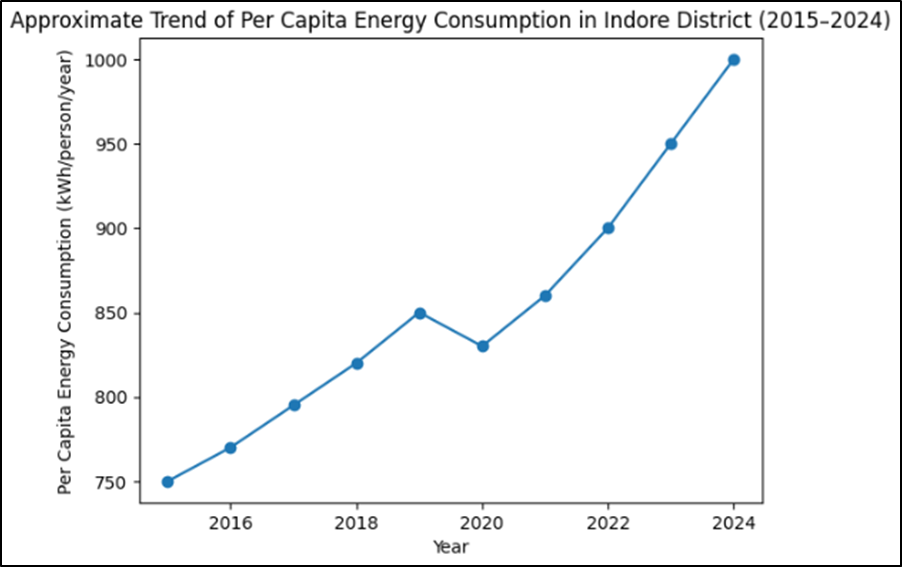
This figure was calculated based on total electricity consumption in the city divided by its population for that period. Therefore, there is a steep per head electricity consumption in after 2020 due to covid-19 that initiated the demand and use of electric appliances, work from home trend and internet-based things that requires electricity.
Scenario of Energy Consumption & Distribution
Although official district-level annual energy consumption figures for Indore in 2025 are not published by central or state energy agencies, utility reports indicate that Indore’s peak electricity demand has substantially increased over recent years (e.g., from ~541 MW in 2019 projected at approximately 760 MW in 2025. According to the 20th Electric Power Survey (EPS) report, which is used as an official planning document for forecasting Indian city loads:
- In 2022–23, Indore’s total electricity requirement was about 3,106 MU (million units).
Based on these patterns, the estimated annual energy requirement for Indore District in 2025 falls in the range of approximately 3,200 – 3,600 GWh (3,200,000 – 36,00,000 MWh). Indore’s daily electricity consumption in high-demand periods (like summer or festivals) has been reported in the range of ~1 crore to 1.5 crore units per day (~10–15 GWh/day).
In August 2025, more than 32 crore units (32 GWh) were supplied in a single month, which suggests sustained high consumption. The maximum electricity demand in Indore is estimated to reach around 760 MW in peak summer months (April–May) in 2025. This is the peak instantaneous load, not annual energy, but it is an official projection by the local distribution utility (MPPKVVCL).
Energy Consumption by Sector (Electricity)
According to sector consumption statistics compiled for Indore (for example, the Climate Change and Environment Action Plan and utilities data around FY 2019-20):
1. Agriculture Sector → ~46.3 % of Electricity Use
- Agriculture is the largest single electricity-consuming sector in Indore District, driven by irrigation and farm-related power supply.
2. Domestic/Residential Sector → ~21 %
- Household electricity use (lighting, appliances, fans/coolers/ACs, cooking, pumps, etc.) accounts for roughly one-fifth of district consumption.
3. Industrial Sector → ~23 %
- Industries (especially units around Pithampur–Indore–Dewas industrial belts) consume a significant share of electricity. Large and expanding industrial connections make up a major load in the grid.
4. Commercial Sector → ~6 %
- Commercial establishments such as shops, offices, malls, and small businesses account for a smaller share compared to agriculture and industry.
5. Public Works and Street Lighting → ~4 %
- These are smaller but visible parts of the overall demand in the district.
6. Electric Vehicles / Other Uses → ~0.1 %
- As of the analysed period, EV and similar emerging uses contributed a very minor share.
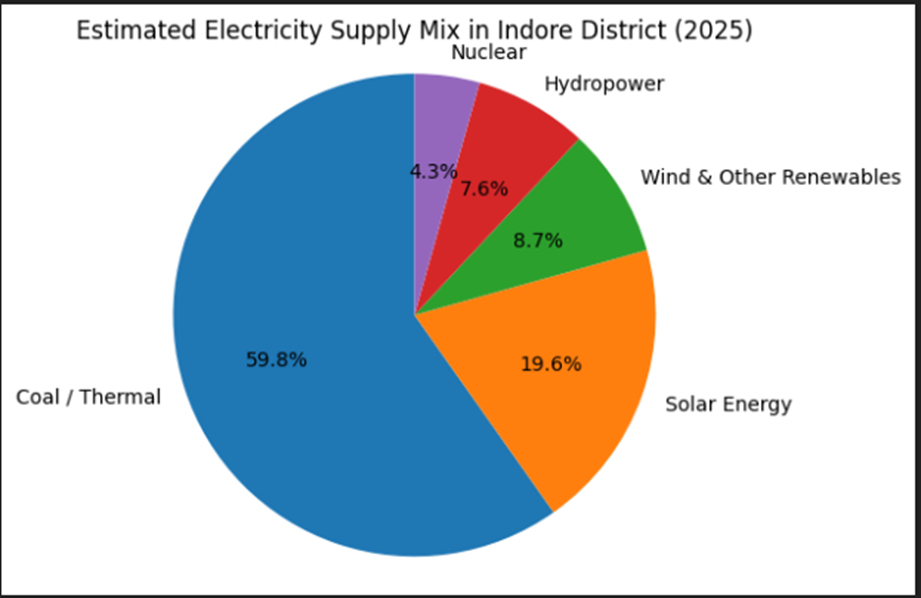
To meet the needs of sectors the energy demand is still fulfilled by grid supply based on fossil fuels majorly. Below is a pie chart whose compilation is based on the data estimation is based on regional generation and grid procurement patterns reflecting state-level energy capacity data, Local solar generation capacity achievements and targets and dispatch patterns from the state and national power grid.
Figure X below shows the estimated electricity supply mix for Indore District in 2025. Coal-based thermal power remains the dominant source, contributing around 55–60% of total electricity supply. Solar energy has emerged as a significant contributor with nearly 18–20% share, reflecting rapid growth in rooftop and grid-connected solar installations. Wind and other renewable sources account for about 8–10%, while hydropower contributes roughly 7–8%. Nuclear power provides a small but stable share of around 4%. The supply mix highlights Indore’s increasing transition towards renewable energy, although dependence on coal-based generation remains substantial.
Major issues & challenges in meeting growing energy demand
Projected Electricity Demand for Indore by 2030
1. Energy Requirement Forecast from the 20th Electric Power Survey
According to the 20th Electric Power Survey (EPS) report, which is used as an official planning document for forecasting Indian city loads:
- In 2022–23, Indore’s total electricity requirement was about 3,106 MU (million units).
- It is projected to reach approximately 3,716 MU by 2027–28, assuming a 3.65 % Compound Annual Growth Rate (CAGR).
| Year (approx.) | Annual Electricity Requirement (MU) | Peak Demand (MW) |
| 2022–23 | ~3,106 MU | ~630 MW |
| 2027–28 (projected) | ~3,716 MU | ~852 MW |
| 2030 (interpolated) | ~4,000–4,300 MU | ~1,000 MW+ |
| 2032–33 (forecast) | ~4,379 MU | ~1,133 MW |
Since district has no major thermal power plant or hydroelectricity plant, most of the energy is supplied based on grid supply therefore increasing energy demand poses a problem to fulfil national sustainable goals of replacing the dependency on fossil fuels.
2. Rapid urbanisation and increasing energy demand
Urbanisation in Indore district is increasing rapidly due to:
- Migration from rural MP.
- Expansion of IT, education, healthcare, and industrial sectors.
- Smart City & Metro projects.
According to the 2011 Census, Indore District’s urban population comprised 74.09 % of the total population. Based on subsequent population growth estimates and urban agglomeration projections, the district’s urbanisation level is estimated to have increased to approximately 80 % by 2025 and is projected to reach about 82 % by 2030. This reflects sustained urban migration, infrastructure expansion, and increasing incorporation of rural peripheries into the urban fabric.
3. High Residential Load Driven by Cooling Appliances
- Indore has around 2 lakh air conditioners, 3 lakh coolers, 6 lakh refrigerators, and 20 lakh fans installed in homes — indicating heavy residential energy use.
- For every 1 °C rise above 38 °C, demand increases by about 5 lakh (500,000) units, showing how sensitive demand is to temperature.
4. Rising Industrial Electricity Consumption
Industrial growth in and around Indore (including Malwa & Nimar regions) is a significant driver of energy demand.
- In the year through June 2025, industries consumed 835 crore (8.35 billion) units of electricity—an increase from 773 crore units the previous year.
- In the first quarter of FY 2025, industrial consumption rose 7% year-on-year, indicating expanding industrial activity.
Challenge: Industrial expansion increases load on the grid, especially for high-tension (HT) consumers, requiring robust supply capacity and quality power (stable voltage with minimal outages).
5. Seasonal and Agricultural Load Fluctuations
- Agricultural demand spikes during irrigation seasons (e.g., Rabi), pushing supply needs. In one reported instance in the wider region, total power demand crossed 6500 MW across 15 districts, with over 11.6 crore (116 million) units supplied in 24 hours due to irrigation needs.
Challenge: Seasonal spikes complicate planning, leading to mismatches between supply and demand if infrastructure is not sufficiently flexible.
Sustainable Solutions
1. Smart Meters on Distribution Grid Components
The distribution utility, Madhya Pradesh Paschim Kshetra Vidyut Vitaran Company Limited (MPPKVVCL), is not only installing smart meters on residential and commercial connections but also:
- Installing smart meters on 11 kV feeders and at transformers to enable real-time monitoring of electricity supply and load at various grid points.
- Over 5.25 lakh smart meters have been installed in Indore city alone — the highest number among districts in the Malwa-Nimar region. Reports cite that earlier smart metering efforts (beginning with about 1.10 lakh meters) helped curb power theft and line losses, with recovered value estimated up to ₹50 crore before the broader rollout began.
2. Blockchain-Enabled Peer-to-Peer (P2P) Energy Trading
Blockchain allows households with rooftop solar to sell surplus energy directly to others, bypassing traditional utility channels.
- Enhances local energy markets
- Encourages rooftop solar adoption
3. Large-Scale Battery Energy Storage Systems (BESS)
: BESS enables renewable energy (like solar/wind) to be stored and used when demand peaks—critical for variable renewable resources.
- India’s BESS installations rapidly increased from 51 MWh in 2023 to 442 MWh by Dec 2024. Capacity requirements are projected at 74 GW / 411 GWh by 2032 to support renewable targets.
Benefits for Indore: - Smoothens solar/wind output fluctuations
- Reduces peak power purchases
- Enhances reliability and local grid stability
4. Decentralised Microgrids
What it is: Small, local grids powered by local renewable sources (solar + storage) that can operate independently or with the main grid.
- Microgrids reduce long transmission lines and losses, and supply critical facilities (hospitals, water treatment, EV charging) during outages.
Advantages for Indore:
- Local resilience during blackouts
- Lower T&D losses
5. Digital Demand Forecasting Using AI/Deep Learning
Smart forecasting models—trained on historical energy data, weather, and consumer behaviour—can optimize generation schedules and reduce wastage.
- Academic research shows AI-based systems can reduce carbon emissions by ~79%, improve cost savings by ~24%, and boost renewable utilization by ~13%.
6. Urban Distributed Renewable Expansion (Rooftop + Community Solar)
India’s rooftop solar potential is huge: around 637 GW nationally, yet only ~11.87 GW installed as of 2024.
- Policies targeting 100 GW rooftop solar add ~100 GW to the distributed grid by 2030.
Rooftop Solar in Indore District:
| Year / Metric | Rooftop Solar Capacity | Installed Systems |
| 2025 (current) | ~100–110 MW | ~24,000+ rooftops (~60% residential) |
| Target by 2027 | ~300 MW (city goal) | Continued growth with thousands more rooftops |
| Estimated by 2030 | ≥ 300 MW (likely more) | Expansion across residential & commercial |
Conclusion
A combination of renewable energy expansion, energy efficiency, smart infrastructure, and policy support can help Indore District meet its future energy demand sustainably. These measures will not only ensure energy security but also contribute to environmental protection and climate resilience.
References
- Ministry of New and Renewable Energy (MNRE), Government of India. (2024). National rooftop solar programme and PM Surya Ghar Muft Bijli Yojana guidelines. Retrieved from https://mnre.gov.in
- Indore Municipal Corporation. (2023). Solar City Mission and renewable energy action plan. Indore, India.
- Times of India. (2025). Western DISCOM distributes ₹202 crore in solar subsidies under rooftop solar schemes.
- Energyworld. (2023, May 4). Plan to transform Indore into ‘Solar City’, generate 300 MW rooftop energy.
- Free Press Journal. (2025, February 14). Indore leads in Malwa-Nimar with over double rooftop solar plants.