
| Sandeep Kumar Soni Research Scholar Sant Gahira Guru Vishwavidyalaya Ambikapur, Sarguja (C.G.) | Dr. Seema Mishra Assistant Professor and Head of Department (Geography) Holy Cross Women’s College Ambikapur, Sarguja (C.G.) |
Abstract
Surajpur and Surguja districts are found in the northern part of Chhattisgarh and are blessed with natural sceneries, spiritual hubs, archeological sites and rich tribal culture. Although these districts are endowed with various tourism resources, they are yet to establish a niche in the state tourism. The current paper evaluates the developmental potential of tourism in terms of inter districts tourism circuit-based approach, whereby in a systematic and interrelated network, several destinations are incorporated to increase the flow of tourists and development in the regions. The study relies on the observations of various tourist places and on the secondary data, comprising of formally recognized tourist sites, as well as the statistics of tourist arrivals (2020 to 2024) in the administrative reports of the Tourism Department, Government of Chhattisgarh. The results indicate that despite the constant increase in the general tourist inflow in the state since the COVID-19 period, the share of Surajpur and Surguja is comparatively low. The paper suggests religious, natural and archaeological-historical tourism circuits to be developed together. It finds that the systematic planning, the improvement of infrastructure, marketing strategies and the involvement of the community can help make the region an emergent tourism center in northern Chhattisgarh.
Keywords: Tourism Circuit, Regional Development, Surajpur, Surguja, Chhattisgarh Tourism.
I. Introduction
Tourism has grown to be one of the most vibrant industries of the world-wide economy and it has consequently provided a significant contribution to job creation, foreign exchange, aiding infrastructural enhancement and cultural exchange. Tourism in the developing economies like India has a significant role of minimizing regional gap as well as ensuring inclusive development. The Government of India has been more and more focused on the development of the tourism circuits through a number of schemes including the thematic and regional circuit planning. A tourism circuit is a group of interrelated tourist attractions connected with the help of a carefully designed travel course, which prompts tourists to visit several attractions in a specific geographical region. This kind of strategy improves the travel mobility of the tourists; higher average length of stay and boosts activities on the local economy. Begampure (2024)describes a tourist circuit as an intended path of travel that comprises of at least three significant and discrete tourist destinations. There should be a clear entry and exit point of such a circuit. Its construction must trigger tourists to visit the majority of the recognized attractions in the circuit after entering them. In the north of the state of Chhattisgarh, there are the districts of Surajpur and Surguja that are endowed with the natural beauty, religious interest, archeological remains and customs of tribes. Their potential is however not fully exploited because of lack of a systematic tourism planning and integrated circuit development. This paper tries to examine the opportunities in the development of tourism in these districts using a tourist circuit approach.
II. Study Area Profile:
Surajpur and Surguja districts are located in the northern part of Chhattisgarh state. Surguja district covers 5,732 sq. km (Website Surguja Administration, 2026) while Surajpur covers 4996.26 sq. km (Website Surajpur Administration, 2026). Surajpur was carved out of Surguja district in 2012 as a separate administrative unit. According to Census of India, 2011 Surguja has a population of 8,40,352 while Surajpur has 7,89,043 residents. Surajpur district consists of six development blocks: Surajpur, Bhaiyathan, Odgi, Ramanujnagar, Premnagar and Pratappur. Similarly, Surguja district comprises seven development blocks, namely Ambikapur, Lakhanpur, Udaipur, Mainpat, Sitapur, Lundraand Batauli. These administrative divisions play an important role in regional planning, resource management and tourism development within the study area.The region lies between 22°37′ N to 23°55′ N latitude and 82°30′ E to 83°42′ E longitude. The physical landscape, combined with tribal culture, historical monuments and religious sites makes it highly suitable for tourism circuit development. (Map- 01 & 02)
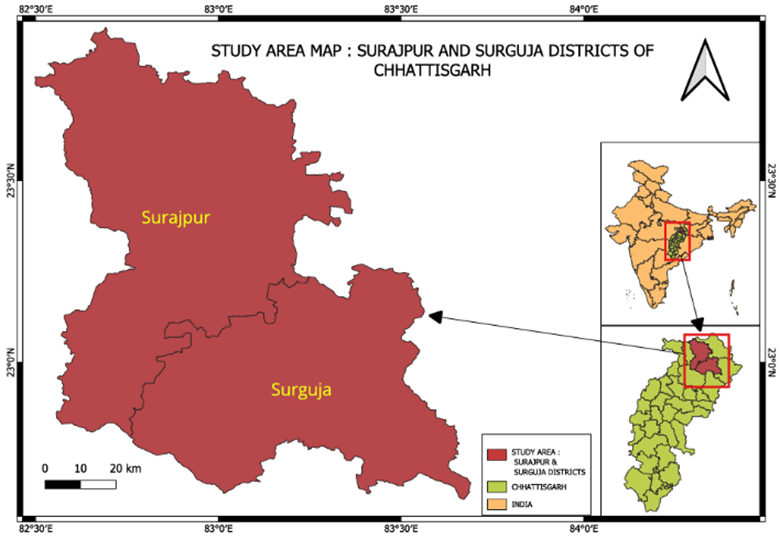
Map-01: map created by author by qgis 3.36.3-maidenhead software
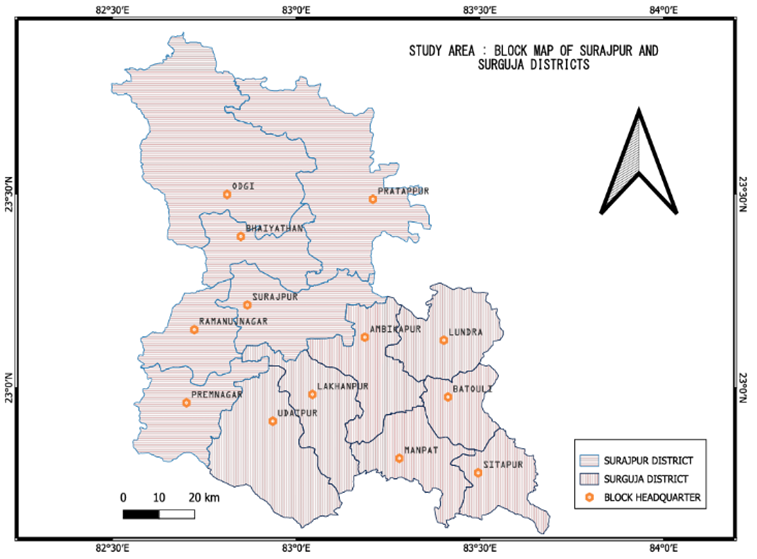
Map-02: map created by author by qgis 3.36.3-maidenhead software
III. Objectives of the Study
1. To measure the development potential of tourism using a circuit-based approach.
2. To determine the key tourism resources within the areas of Surajpur and Surguja
districts.
3. To determine the trends in tourist inflow between 2020 and 2024.
4. To recommend appropriate tourism circuits to be used in the integrated regional
development.
IV. Review of Literature
The value of systematic planning in the development of tourism has been emphasized in previous studies.
Nair & Augustine (2005) studied the tourism brand promotion strategies and marketing practices in Kerala. The research concludes that the word of mouth has the greatest impact on tourist information. According to the survey findings, 40 percent of the tourists come to sightsee and 20 percent to see the culture and heritage. There is also an adequate transport and communication infrastructure but the roads need to be well maintained and the infrastructure should be improved. This research finds that tourism development depends on planned development, proper marketing and infrastructure improvement. These can be applied in the tourism circuit development research that is concerned with promotion, use of resources and strengthening of infrastructures.
Guntuka et al. (2016) considered planning of tourist circuits in Greater Hyderabad with the help of GIS and nearest neighbor analysis to determine the spatial group of attractions. The paper defines six key tourist clusters and indicates that the tourism destinations are clustered in 200 meters buffer zones with distance decay trends. The study focuses on spatial visualization and planning of sightseeing and tour design as a cluster. Its application is in the case of tourism circuit development such as Surajpur and Surguja.
Senthilkumaran & Partho (2018)mentioned that domestic and religious tourism is an essential aspect of tourism in India and that scientific planning is a necessity when developing tourism circuits.
Sati (2018)discussed tourism carrying capacity and destination development in the Gangotri pilgrims circuit Carrying capacity analysis and the researcher observes that the rich natural and religious heritage is in poor infrastructure and prone to environmental risks. It suggests a sustainable planning and better transportation, sanitation and local participation in order to make the tourism development in vulnerable Himalayan areas balanced.
Siddhi Rajeshkumar Vakharia & Shah (2020) offered a Heritage Tourist Circuit Triangle in Madhya Pradesh between Gwalior, Orchha and Khajuraho to improve heritage tourism and the growth of the region. The article points out that Indian cultural heritage and historical sites have a high potential of drawing local and foreign tourists. According to it, a tourist circuit refers to a path that connects significant destinations that have a shared theme and with a well-organized connectivity. The authors examine the historical and the cultural importance of the three destinations and propose a circuit itinerary enabling the tourists to visit monuments, temples, forts and cultural sites in less than a week. The paper is based on a secondary source of data and observations during travels to develop the route and schedule. It also underlines the necessity to have better infrastructure, preservation of monuments and transport facilities to boost tourism growth. In general, the suggested circuit will encourage the preservation of the heritage, create jobs, boost local revenues and lead to the socio-economic development of the area.
A. P. Singh et al. (2023) used secondary data (2015 to 2021), tourism statistics to study the theme of religious tourism circuits in Uttar Pradesh. It identifies the important circuits such as the Buddhist, Ramayana, Awadh, Braj, Vindhya- Varanasi and Sikh circuits. The paper indicates a steady increase in the number of tourists up to 2019, after which the figure of tourists dropped during COVID-19.It also discusses the issue of infrastructural discontinuities and the issue of policy campaigns concerning the promotion of tourism. The study can be used in planning tourism intervals and regional tourism development on the premise of governmental policies.
Begampure (2024) explored the potential and infrastructural development of the religious tourism area in Maharashtra and the importance of tourism as an important factor in socio-economic development. The paper describes a tourism circuit as an interrelationship involving at least three significant tourist attraction sites with well-stipulated entry and exit points, which allow a tourist to experience various tourist attraction sites in a pre-stated plan.
Rudraakshi Tiwari et al. (2025) explored the infrastructural challenges that hinder the growth of tourism circuits in India and more specifically dwell on transport, accommodation, sanitation, digital connection and tourist facilities. The article evaluates the national initiatives such as Swadesh Darshan and PRASAD Schemes and explains failure to implement and integrate. It classifies the challenges through case studies and literature review into transportation, civic facilities, safety, signage and management issues. In the results, poor connectivity, poor waste management and inadequate accommodation are observed as the major challenges. The paper provides policy-based recommendations on the way in which the tourism circuit can be developed in a sustainable and integrated way.
However, most of the existing studies are large-state or metropolitan-based. The gap in the current research can be noticed on the topic of the integrated tourism circuit planning on the district level in smaller or rather less developed districts such as Surajpur and Surguja.
V. Research Methodology
The current research embraces the exploratory and descriptive research designs to explore tourism development and circuit potential. In this study Primary data were gathered by field observation of chosen tourist attractions by the author and the Secondary data were taken through Administrative Reports (2020-21 to 2024-25) of the Tourism Department (Government of Chhattisgarh). Exploratory approach determines the key tourism resources and circuit possibilities and the descriptive approach is used to examine the current trends and patterns. Some of the tools used in the analysis are the percentage analysis of the tourist inflow, comparative trend analysis, systematic classification of tourism resources and circuit conceptualization of spaces in order to measure the potential of the region in terms of tourism development.
VI. Current Status of Tourism in Chhattisgarh (2020–2024)
The administrative report (2020-21 to 2024-25) shows fluctuating but gradually diversifying tourist inflow across districts. The data shows a strong post-pandemic recovery in total tourist inflow. Visitor numbers increased from 30.14 lakh in 2020(Administrative Report, 2021)to 314.91 lakh in 2024(Administrative Report, 2025). The sharp rise after 2021 indicates restored travel confidence and improved tourism promotion. This consistent growth supports tourism circuit development and regional economic expansion strategies. (Table-01)
Table-01: Year-wise Total Tourist Inflow (in Lakh) in Chhattisgarh, 2020–2024
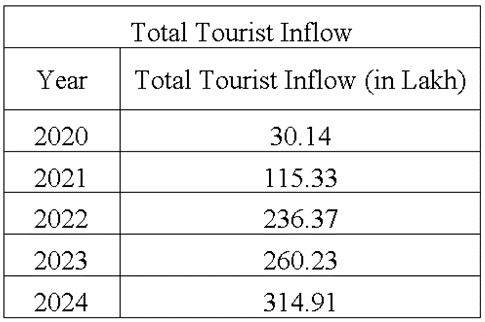
Source: Author’s compilation and analysis based on Administrative Reports (2020-21 to 2024-25) published by the Tourism Department, Government of Chhattisgarh.
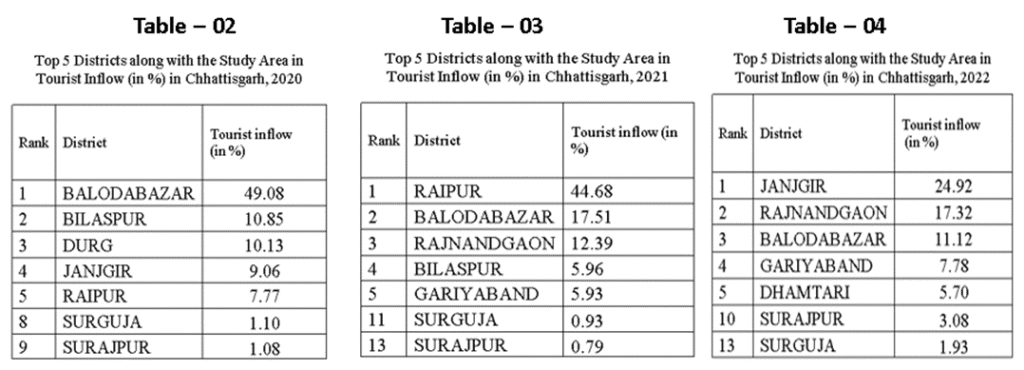
Source: Author’s compilation and analysis based on Administrative Reports (2020-21 to 2024-25) published by the Tourism Department, Government of Chhattisgarh.
Source: Author’s compilation and analysis based on Administrative Reports (2020-21 to 2024-25) published by the Tourism Department, Government of Chhattisgarh.
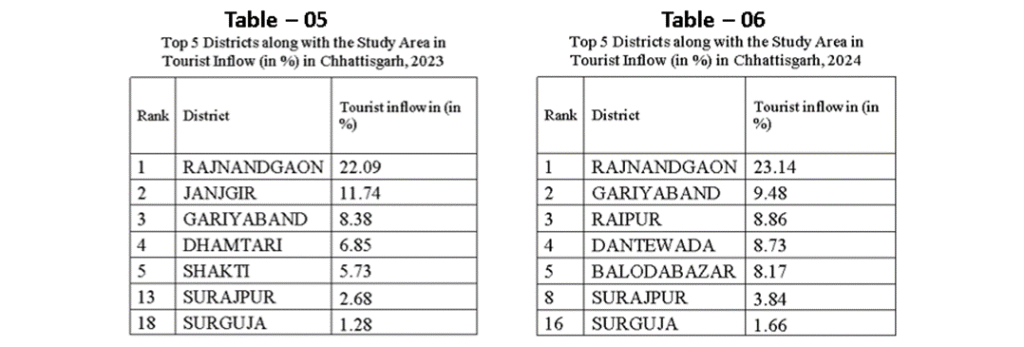
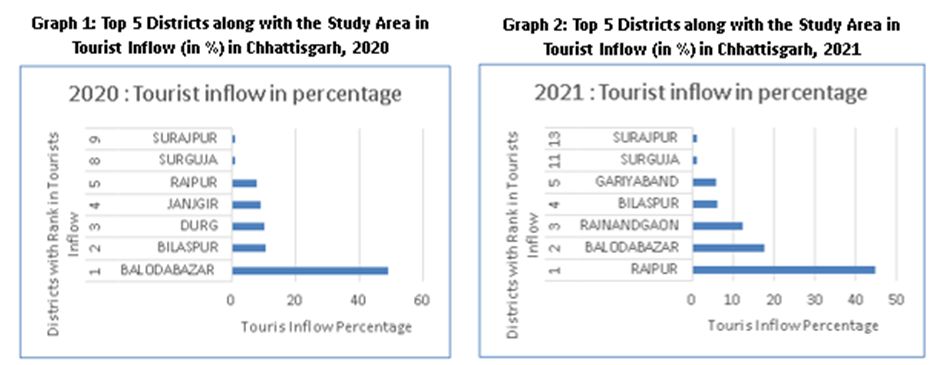
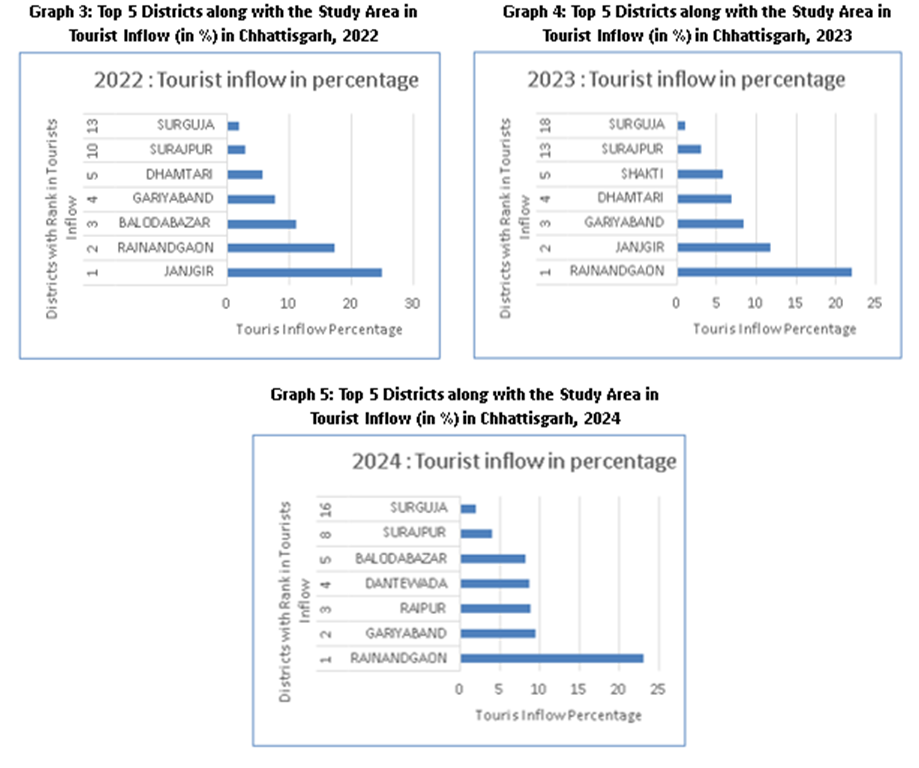
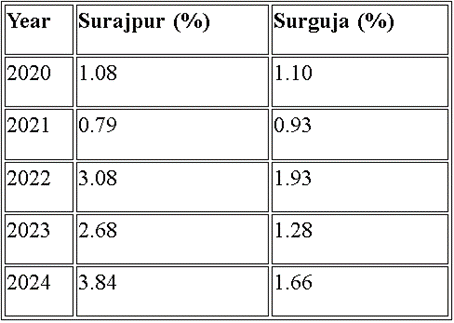
Table-02 to Table-03 and Graph 1 to Graph 5 show that in 2020, Balodabazar had the most inflow (49.08%)(Administrative Report, 2021) and in 2021, Raipur had the most (44.68%) (Administrative Report, 2022). This shows that the pandemic made major centers more crowded. Distribution became more even starting in 2022, with Janjgir and Rajnandgaon being the top districts(Administrative Report, 2023). In 2023, Rajnandgaon was still in first place (22.09%) (Administrative Report, 2024) and in 2024 (23.14%)(Administrative Report, 2025). Surajpur went from 1.08% in 2020 to 3.84% in 2024.Building a tourism circuit can bring a lot more tourists to Surajpur and Surguja. (Table-07 and Graph 6)
Table-07: Year-wise Percentage Distribution of Tourist Inflow in Surajpur and Surguja Districts with Respect to Total Tourist Inflow of Chhattisgarh (2020–2024)
Source: Author’s compilation and analysis based on Administrative Reports (2020-21 to 2024-25) published by the Tourism Department, Government of Chhattisgarh.
Graph 6: Tourist visit in Surajpur and Surguja Districts of Chhattisgarh
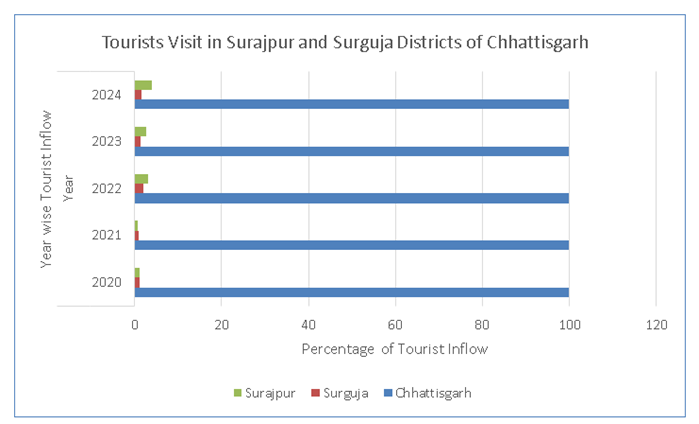
Source: Author’s compilation and analysis based on Administrative Reports (2020-21 to 2024-25) published by the Tourism Department, Government of Chhattisgarh.
The table shows how many individuals traveled to Surguja and Surajpur between 2020 and 2024. The COVID-19 pandemic kept both districts from getting many new residents between 2020 and 2021. There is clear proof that a big recovery will commence in 2022. Surajpur is expanding faster, going from 0.79% in 2021 to 3.84% in 2024. Surguja is growing steadily but not too quickly; by 2024, it will reach 1.66%. The tendency that is going up means that tourism will get better in both areas. The region can provide a more holistic travel experience by creating a tourism circuit uniting the natural, religious and cultural attractions of both Surajpur and Surguja. This would result in the more integrated circuit making tourists spend more time in the region, enhancing the connectivity of the two districts and balanced economic development of the region.
VII. Identification of Tourism Circuits
Based on resource availability, three major circuits are proposed:
Religious Tourism Circuit
The Religious Tourism Circuit in the study area links important holy and pilgrimage sites in the Surajpur and Surguja districts, which makes it easy to plan a trip. National highways and other roads connect the circuit to well-known places like Gadwatiya Dham, Sita Lekhani, Jaleshwar Mahadev, Maa Mahamaya, Ramgarh, the Buddha Temple and Maa Mangrail Garhi. Dam (2016) says that when there are a lot of holy sites on a well-defined tourism circuit, pilgrims want to see more than one of them. This well-planned system makes it easier for tourists to get around, stay longer and bring more people to the area as a whole. Planned growth of religious circuits can help spiritual tourism grow and make sure that the region’s growth is even. (Map-03)
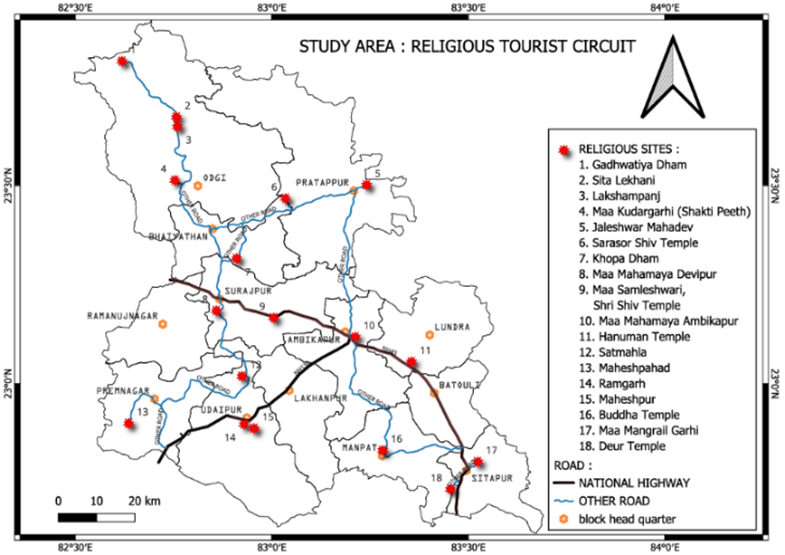
Map-03: Map created by author by QGIS 3.36.3-Maidenhead software
Natural Tourism Circuit
The Natural Tourism Circuit in the study area connects diverse ecological and scenic attractions across Surajpur and Surguja districts. The circuit integrates waterfalls such as Rakasganda and Lafari Rapids, lakes like Kenapara Lake, dams including Ghunghutta and Kunwarpur and remarkable natural phenomena such as Thinthini Stone (stone that sounds like metal), Ulta Pani (reverse water flow site) and Jaljali Jumping Land (bouncing land surface). Tiger Point waterfall and other scenic perspectives make it even more appealing. There are national highways and secondary roads that connect these places to Ambikapur and Surajpur, making them easy to get to. The proposed extension of this circuit can aid eco-tourism, adventure tourism and the area’s long-term growth. It can also assist the environment and produce jobs.
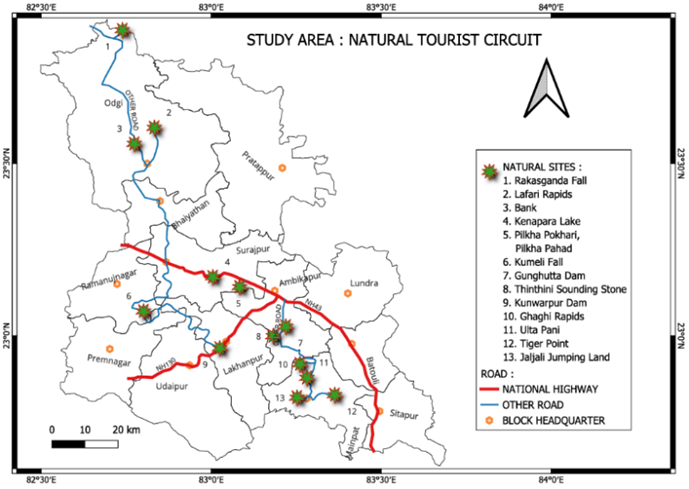
Map-04: Map created by author by QGIS 3.36.3-Maidenhead software
Archaeological and Historical Circuit
Map-05 indicates that an archaeological tourism circuit that is well-planned can bring a lot more tourists to both Surajpur and Surguja districts. The circuit connects national highways and other routes to key cultural sites such Sita Lekhani, Ramgarh andMaheshpur, making it easier to reach to them. Tourists are more likely to visit more than one destination on the same vacation if they plan their route ahead of time. This approach encourages tourists to extend their stay, increase their spending and explore a wider range of attractions in the region. Tourism circuit planning also contributes to the improvement of essential elements such as infrastructure, transportation connectivity and destination promotion.This will help even out the areas and make both districts into up-and-coming heritage tourism spots.
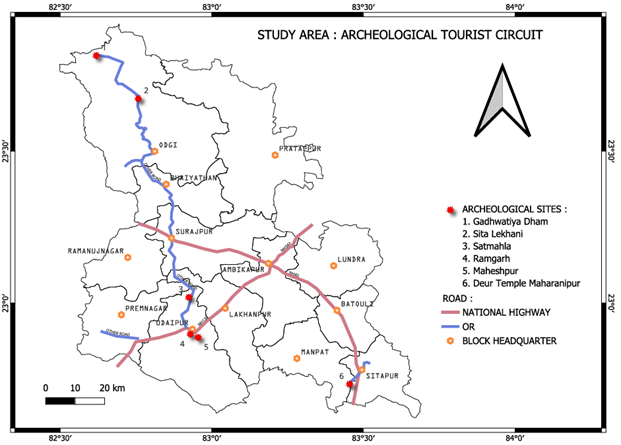
Map-05: Map created by author by QGIS 3.36.3-Maidenhead software
VIII. Discussion
This paper reveals that the approach of tourism circuit to be very effective in enhancing tourism in the Surguja and Surajpur districts. The two districts possess numerous natural, religious and cultural sites, yet the potential of tourism is not available, due to absence of integrated connectivity and coordinated marketing. A Surajpur-Surguja tourism circuit can be combined so that key destinations are linked with designed routes, which will enhance infrastructure in some of the most important routes and induce people to go to more than one destination. This integrated approach will encourage tourists to spend more and extend their duration of stay, thereby contributing to increased employment opportunities.Circuit based tourism can also be used to assist the rural and tribal communities through homestays, handicrafts, cultural programs and eco-tourism programs. This will make the region develop in a sustainable and balanced manner.
IX. Socio-Economic Implications
Developing a tourism circuit in the Surajpur and Surguja districts could have a big impact on the growth of the region. Connecting important religious, natural and cultural sites with an integrated circuit can create direct jobs in hotels, transportation and guiding services. Handicrafts, local food supply and small businesses will all help to create more indirect jobs. Better roads, sanitation and visitor facilities along the circuit corridors will make the infrastructure stronger. The circuit model can also help women and tribal people start their own businesses through cultural tourism and homestays. It will also help protect cultural heritage and preserve heritage while making the north of Chhattisgarh more equal.
X. Suggestions
1. Develop clearly defined tourism circuits with official branding.
2. Improve road connectivity and public transport facilities.
3. Expand accommodation, sanitation, drinking water and signage.
4. Promote homestays and tribal tourism.
5. Strengthen digital marketing and online booking systems.
6. Encourage Public–Private Partnerships (PPP).
7. Use GIS and primary data in future research for scientific planning.
XI. Conclusion
The study finds that Surajpur and Surguja districts have a lot of potential for development based on tourism circuits.From 2020 to 2024, the number of tourists going to the districts has slowly gone up, but the districts still don’t bring in a lot of tourists for the state as a whole. A planned tourism circuit concept that encompasses religious, naturaland archaeological sites can make it much easier for travellers to get around and help the economy thrive. The location can become a major tourism attraction in northern Chhattisgarh if it has better infrastructure, marketing and community involvement.
References-
- Administrative Report. (2021). Tourism Department, Government of Chhattisgarh.
- Administrative Report. (2023). Tourism Department, Government of Chhattisgarh.
- Administrative Report. (2024). Tourism Department, Government of Chhattisgarh.
- Administrative Report. (2025). Tourism Department, Government of Chhattisgarh.
- Begampure, R. (2024). A COMPREHENSIVE STUDY ON THE POTENTIAL AND INFRASTRUCTURE DEVELOPMENT OF RELIGIOUS TOURISM CIRCUIT IN MAHARASHTRA. International Journal of Research in Civil Engineering,Architechure and Design (IJRCEAD), 8(1), 1–6.
- Census of India. (2011). District Census Handbook.
- Guntuka, D., Gopagani, A., & Bhole, V. (2016). TOURIST CIRCUIT PLANNING FOR GREATER HYDERABADCLUSTER IDENTIFICATION – USING GIS. International Journal of Advanced Research, 4(12), 1029–1036. https://doi.org/10.21474/IJAR01/2490
- Nair, R., & Augustine, S. (2005). TOURISM BRAND PROMOTION. SMART Journal of Business Management Studies, 1(2), 77–80. www.IndianJournals.com
- Rudraakshi Tiwari, A., & Gaurav Singh, A. (2025). Infrastructural Challenges In Developing Tourism Circuits. International Journal of Scientific Development and Research, 10(4), 455–460. www.ijsdr.org
- Sati, V. P. (2018). Carrying capacity analysis and destination development: a case study of Gangotri tourists/pilgrims’ circuit in the Himalaya. Asia Pacific Journal of Tourism Research, 23(3), 312–322. https://doi.org/10.1080/10941665.2018.1433220
- Senthilkumaran, P., & Partho, S. (2018). An Optimisation Model for Decision Making: Travel Path for Tourism Circuits. International Journal of Pure and Applied Mathematics, 119(18), 3059–3065. http://www.acadpubl.eu/hub/
- Siddhi Rajeshkumar Vakharia, E., & Shah, P. S. (2020). Proposal for Heritage Tourist Circuit Triangle in Madhya Pradesh. International Research Journal of Engineering and Technology (IRJET), 7(4), 2157–2164. www.irjet.net
- Singh, A. P., Tripathi, A., & Iftikhar, N. (2023). Tourism in Uttar Pradesh: An Analytical Study of Religious Circuits. INTERNATIONAL JOURNAL OF CREATIVE RESEARCH THOUGHTS (IJCRT), 11(11), 362–370.
- Website Surajpur Administration. (2026, March 9). Govt. of Chhattisgarh. https://surajpur.nic.in/
- Website Surguja Administration. (2026, March 9). Govt. of Chhattisgarh. https://surguja.gov.in/en/