
| Dr. Amritesh Shukla (Assistant Professor) Indira Gandhi Govt.P.G. College Vaishali Nagar, Bhilai, Durg. |
Abstract
Women’s economic empowerment has emerged as a central concern in contemporary development discourse, particularly in developing countries where gender disparities in income, employment, and decision-making persist. Governments increasingly use welfare programs and direct benefit transfer mechanisms to enhance women’s financial autonomy and social status. In this context, the Government of Chhattisgarh launched the Mahatari Vandan Yojana (MVY) in March 2024 to provide financial assistance of ₹1,000 per month to eligible married women through the Direct Benefit Transfer (DBT) system. The scheme aims to improve women’s economic independence, enhance financial inclusion, and strengthen household welfare. This study examines the role of Mahatari Vandan Yojana in promoting economic empowerment among women in Chhattisgarh. The research is based on secondary data collected from government reports, budget documents, and scholarly literature on women’s empowerment and social welfare policies. The study analyses beneficiary coverage, financial allocation, and the socio-economic impact of the scheme using descriptive statistics and simple regression analysis. The findings indicate that the scheme has significantly improved women’s access to financial resources, increased their participation in household decision-making, and strengthened financial inclusion among rural and marginalized communities. With more than 68 lakh beneficiaries and substantial financial transfers exceeding ₹15,000 crore, the scheme has emerged as a major gender-focused welfare initiative in the state. However, the study also highlights challenges related to fiscal
sustainability, beneficiary verification, and the need for complementary policies such as skill development and employment generation. The paper concludes that while Mahatari Vandan Yojana has made a significant contribution toward women’s economic empowerment, its long-term success depends on integration with broader developmental strategies aimed at enhancing women’s capabilities and economic opportunities.
Keywords: Women’s empowerment, Mahatari Vandan Yojana, Chhattisgarh, Direct Benefit Transfer, gender equality, social welfare policy, financial inclusion.
Introduction
Women’s empowerment has become one of the most important objectives of development policies in the twenty-first century. Economic empowerment, in particular, plays a vital role in enabling women to participate actively in social, political, and economic life. Access to financial resources enhances women’s autonomy, improves household welfare, and contributes to inclusive economic growth. However, in many developing societies, women continue to face structural barriers such as limited access to education, employment opportunities, and financial services. These barriers restrict their ability to achieve economic independence and participate effectively in decision-making processes.
India has made considerable progress in promoting gender equality through various welfare programs and policy initiatives. Nevertheless, significant disparities remain in terms of women’s labor force participation, income levels, and access to financial resources. In response to these challenges, both the central and state governments have introduced a number of schemes aimed at improving women’s socio-economic status. These initiatives include programs focusing on financial inclusion, skill development, and social protection.
Chhattisgarh, a relatively young state formed in the year 2000, has a predominantly rural population and a significant proportion of tribal communities. Women in the state play a crucial role in agriculture, forest-based livelihoods, and household management. Despite their contributions, many women remain economically dependent on male members of the family and have limited access to financial resources. Recognizing these challenges, the Government of Chhattisgarh introduced the Mahatari Vandan Yojana in March 2024.
The scheme provides financial assistance of ₹1,000 per month to eligible married women aged 21 years and above. The amount is transferred directly to beneficiaries’ bank accounts through the Direct Benefit Transfer mechanism. The primary objective of the scheme is to provide financial security to women and strengthen their role in household decision-making. By ensuring a regular source of income, the program seeks to promote financial independence and enhance women’s participation in the formal financial system.
The present study attempts to examine the role of Mahatari Vandan Yojana in promoting economic empowerment among women in Chhattisgarh. The research analyses the scheme’s implementation, financial allocation, and impact on women’s socio-economic conditions.
Objectives of the Study
The main objectives of the study are as follows:
- To examine the objectives and institutional framework of Mahatari Vandan Yojana.
- To analyze beneficiary coverage and financial allocation under the scheme.
- To assess the impact of the scheme on women’s economic empowerment in Chhattisgarh.
- To identify the challenges associated with the implementation of the scheme and suggest policy recommendations.
Research Methodology
The present study adopts a descriptive and analytical research design. The analysis is based primarily on secondary data collected from government publications, policy documents, budget reports, and scholarly literature on women’s empowerment and welfare policies.
Data relating to the number of beneficiaries and financial transfers were compiled and analyzed using descriptive statistical methods. Tables and graphical representations are used to present trends in beneficiary coverage and government expenditure. In addition, a simple regression analysis is used to examine the relationship between the number of beneficiaries and the financial allocation under the scheme.
The study focuses on evaluating the socio-economic impact of the scheme and does not involve primary field surveys. However, the analysis draws upon existing literature and policy reports to understand the broader implications of the scheme for women’s empowerment.
Literature Review
The concept of women’s empowerment has been widely discussed in development literature. Amartya Sen (1999) emphasized that development should expand individuals’ capabilities and freedoms, including women’s ability to participate in economic and social activities. According to Sen, economic independence plays a crucial role in enhancing women’s agency and improving their bargaining power within households.
Naila Kabeer (2012) defined women’s empowerment as the process through which women gain the ability to make strategic life choices in contexts where such ability was previously denied. She argued that access to financial resources, employment opportunities, and education are critical factors that contribute to women’s empowerment.
Esther Duflo (2012) observed that empowering women economically can lead to improved developmental outcomes, particularly in areas such as health, education, and child welfare. Studies have also shown that when women control financial resources, they tend to invest more in family welfare compared to men.
In the Indian context, various studies have highlighted the importance of social welfare programs in promoting women’s empowerment. Direct Benefit Transfer schemes have been recognized as effective tools for improving financial inclusion and reducing corruption in welfare distribution. However, scholars also emphasize that income support programs should be complemented by skill development, employment opportunities, and institutional support to ensure sustainable empowerment.
Overview of Mahatari Vandan Yojana
Mahatari Vandan Yojana is one of the most significant welfare initiatives introduced by the Government of Chhattisgarh to support women’s economic empowerment. The scheme aims to provide financial assistance to married women aged 21 years and above who belong to economically weaker sections of society.
The scheme operates through the Direct Benefit Transfer mechanism, ensuring that funds are transferred directly into beneficiaries’ bank accounts. This approach reduces administrative inefficiencies and enhances transparency in the implementation process. By providing a regular monthly income, the scheme seeks to improve women’s financial security and encourage their participation in economic activities.
Graph 1: Growth in Number of Beneficiaries
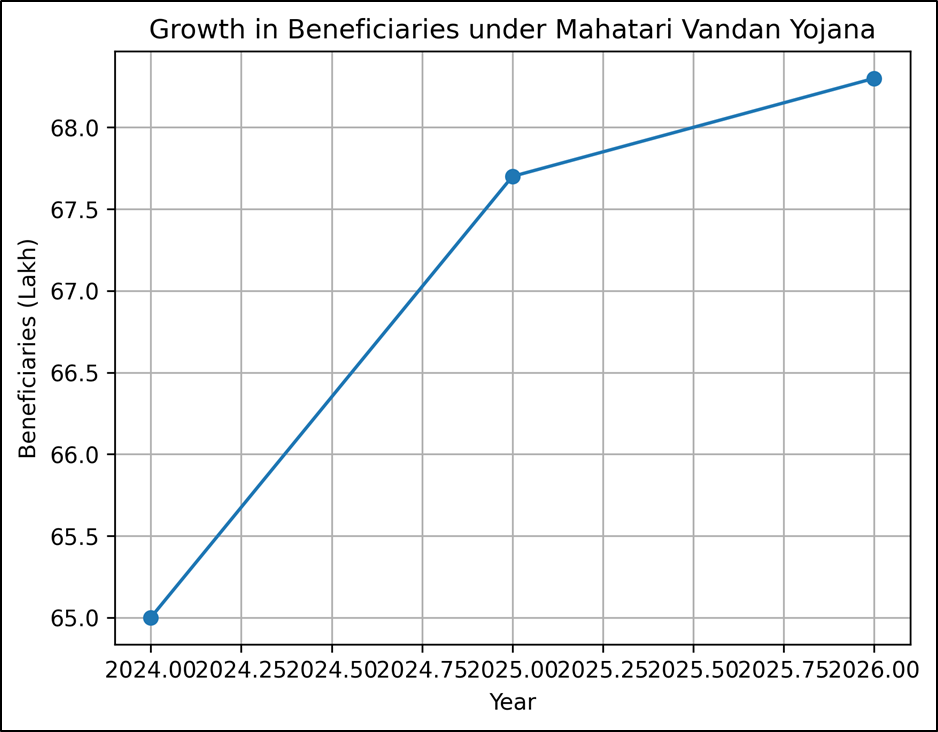
The graph highlights the rising expenditure under the scheme as coverage expands.
Key Features of Mahatari Vandan Yojana
Feature Description
Launch Year 2024
Implementing Authority Government of Chhattisgarh
Target Beneficiaries Married women aged 21 years and above
Financial Assistance ₹1,000 per month
Payment Mode Direct Benefit Transfer
Primary Objective Women’s economic empowerment
Beneficiary Coverage and Financial Allocation
Since its launch, the scheme has achieved significant coverage across the state. A large number of women, particularly from rural and economically disadvantaged communities, have benefited from the program.
Impact on Women’s Economic Empowerment
Increase in Household Income
One of the most immediate effects of Mahatari Vandan Yojana is the increase in household income for economically weaker families. Although the monthly amount of ₹1,000 may appear modest, it provides a reliable source of supplementary income for many households. Women often utilize this financial assistance for purchasing essential goods, supporting children’s education, and covering healthcare expenses.
Promotion of Financial Inclusion
The scheme has contributed significantly to expanding financial inclusion among women. By requiring beneficiaries to have bank accounts, the program encourages women to engage with formal financial institutions. As a result, many women who previously had limited access to banking services are now able to participate in the formal financial system.
Strengthening Household Decision-Making
Access to independent financial resources enhances women’s bargaining power within households. Women who receive financial assistance under the scheme are more likely to participate in decisions related to household expenditures, education, and healthcare.
Social Security and Poverty Reduction
Direct cash transfer schemes provide an important form of social protection for vulnerable groups. The Mahatari Vandan Yojana reduces financial vulnerability and improves the overall quality of life for many families in the state.
Challenges in Implementation
Despite its positive impact, the scheme faces several challenges. Ensuring accurate identification of eligible beneficiaries remains a major administrative task. Errors in beneficiary selection could lead to exclusion of deserving individuals or inclusion of ineligible beneficiaries.
Another challenge is fiscal sustainability. Providing monthly financial assistance to more than 68 lakh women requires substantial budgetary resources. As the scheme expands, maintaining its financial sustainability will require careful planning and efficient resource management.
In addition, limited financial literacy and inadequate banking infrastructure in remote rural areas may hinder effective utilization of the scheme’s benefits.
Policy Recommendations
To enhance the effectiveness of Mahatari Vandan Yojana, several policy measures can be considered. The scheme should be integrated with Self-Help Group programs to encourage savings and entrepreneurship among women. Financial literacy programs should be organized to help beneficiaries better manage their finances.
Furthermore, linking the scheme with skill development initiatives can enable women to engage in income-generating activities. Regular monitoring and evaluation mechanisms should also be established to assess the scheme’s impact and identify areas for improvement.
Conclusion
The Mahatari Vandan Yojana represents an important step toward promoting women’s economic empowerment in Chhattisgarh. By providing direct financial assistance to millions of women, the scheme enhances financial security, strengthens financial inclusion, and improves household welfare. The program has already benefited more than 68 lakh women and involves financial transfers exceeding ₹15,000 crore. These achievements highlight the scheme’s significance as a gender-focused welfare initiative. However, long-term empowerment requires a comprehensive approach that includes education, employment opportunities, and skill development. If effectively implemented and integrated with broader development policies, Mahatari Vandan Yojana has the potential to serve as a model for similar programs aimed at promoting women’s empowerment in other states of India.
References, Notes and Bibliography:
- Agarwal, B. (1997). Bargaining and gender relations within the household. Feminist Economics, 3(1), 1–51.
- Dreze, J., & Sen, A. (2013). An uncertain glory: India and its contradictions. Princeton University Press.
- Duflo, E. (2012). Women empowerment and economic development. Journal of Economic Literature, 50(4), 1051–1079.
- Kabeer, N. (2012). Women’s economic empowerment and inclusive growth. International Development Research Centre.
- Klasen, S., & Lamanna, F. (2009). Gender inequality and economic growth. Feminist Economics, 15(3), 91–132.
- NITI Aayog. (2022). Women empowerment in India: Policy perspectives.
- Sen, A. (1999). Development as freedom. Oxford University Press.
- UN Women. (2020). Women’s economic empowerment strategy.
- World Bank. (2018). Women, business and the law.
- Government of Chhattisgarh. (2024). Mahatari Vandan Yojana operational guidelines.
- Ministry of Finance. (2023). Direct Benefit Transfer Annual Report.