
| Ujjwal Ankur Assistant Professor (Leather Department) NIFT, Delhi (India) | Tulika Mahanti Associate Professor (Leather Department) NIFT, Delhi (India) | Chandrashekhar Joshi Associate Professor (Fashion Communication) NIFT, Jodhpur (India) |
Abstract
This paper investigates the art historical and archaeological significance of carved wells in the Vajjikanchal region of Bihar, focusing on examples from villages such as Lakshmipur Arar, Barka Gaon, Belvar, Karja, and Ramnagar Tonk. The spatial distribution and stylistic features of these wells reflect the region’s layered cultural heritage, deeply intertwined with Buddhism through its association with the final retreats of the Buddha, Jainism as the birthplace of Mahavira and Hinduism, as part of the ancient Vajji Mahajanapada. By analyzing the intricate patterns carved into the stone, the study reveals the sophisticated craftsmanship embedded within these vernacular structures. Utilizing a combination of digital renderings and traditional line drawings, this research recovers and reinterprets artistic details that might otherwise have been lost to time. The study not only enriches our understanding of regional art practices but also positions these carved wells as vital expressions of aesthetic and spiritual life in early Indian history.
Keywords: Attia Hosain, collective memory, nostalgia, Partition, homeland, identity, Muslim aristocracy, Indian English literature.
Introduction
The carved wells of Vajjika region provide an interesting contrast. Exquisite motifs, fishes, flowers and vine are naturalistically drawn but within a structure of functionality – wells. These carved wells have been found in different villages like Lakshmipur Arar, Barka Gaon, Belvar, Karja, Ramnagar Tonk.
This unique form of well decoration, particularly on the interior, is rarely found in any other civilization. These ancient remains serve as testaments to the region’s rich history, art, and culture, which continue to evolve over time.
Several ancient wells in this region exhibit intricate interior carvings, and many more likely remain undiscovered. However, the majority of the found wells are not well preserved. Some have been covered due to past accidents, others have dried up, and some contain toxic waters, rendering them abandoned. Many of these wells are situated in remote areas, concealed by dense vegetation, deterring visitors from approaching. Villagers report that these wells have become habitats for poisonous snakes and other reptiles.
Wells
- Lakshmipur Arar ( 2 wells)
Two of these carved wells have been found in Lakshmipur Arar, the village of Alara Kalama. The Mahaparinibban Sutta and other texts give an account of the Buddha being approached by a minister to the Mallas named Putkasa (Pali: Pukkusa) who told him about his teacher Alara Kalama’s skill in meditation. One day, while deep in meditation, Alara did not hear the sound of a caravan of five hundred wagons that passed by him. The Buddha shared a similar experience; while in the village of Aduma, a rainstorm had frightened four cowherds and two workmen to death, while the Buddha remained calm due to his prowess in meditation.[1]
According to Canto 33 it is mentioned,
Tena kho pana samayena Pukkuso Mallaputto Āḷārassa Kālāmassa sāvako,
Now at that time Pukkasa Mallaputta, a disciple of Āḷāra Kālāma,
Kusinārāya Pāvaṁ addhānamaggapaṭipanno hoti.
was travelling along the highway from Pāvā to Kusinārā
The intrigued Gautama went to Alara Kalama, who taught a kind of early meditation at Vaishali.[2]Alara taught Siddhartha meditation, especially a dhyanic state called the “sphere of nothingness” (Akiṃcanyayatana)[3]
Local people claim that during his final journey, the Buddha paid homage at the samadhi of his teacher. Today, the samadhi of Buddha’s first teacher, Alara Kalama, is still revered by locals under the name Arar Muni’s Samadhi, situated in the same village. It is highly likely that the name Arar is a phonetic corruption of Alara. The substitution of “L” with “R” is also supported by Panini’s grammatical rules.[4]
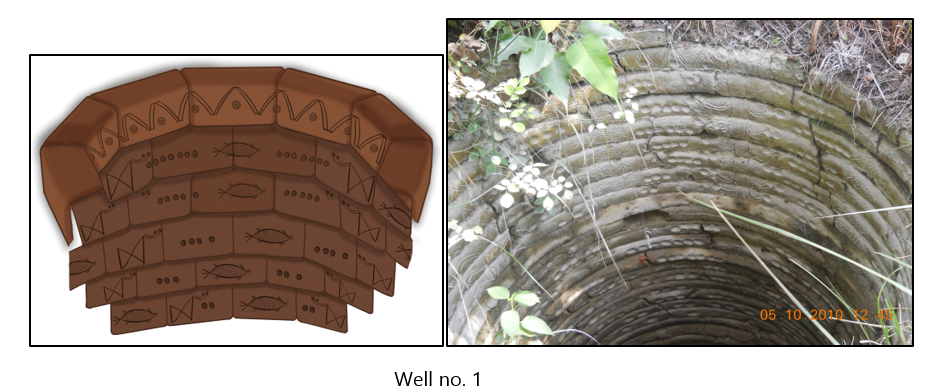
At the first glance one can notice that the wells have a repetition of patterns. However a majority of these are lost to time. Many of these wells that were documents have now been filled up by people in the villages.
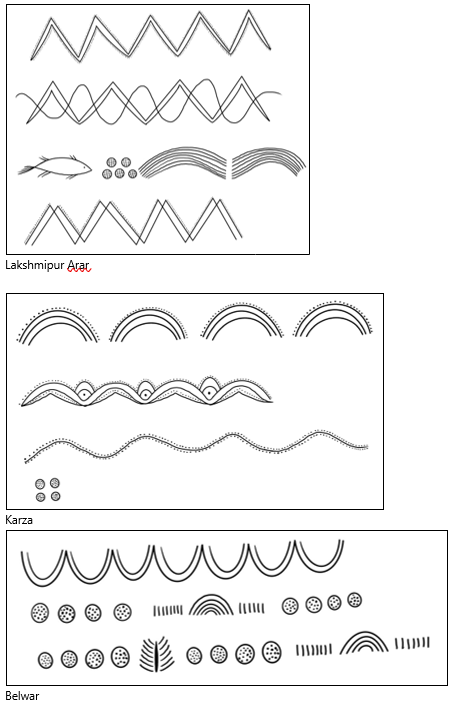
We find two such carved wells in the village of Lakshmipur arar. Well no 1, interestingly has patterns that move both horizontally and vertically. The first row of bricks are carved in double-lined triangles. Within each triangle is a recessed circle. These circles with small projections within it are the major repetitive motif here. It seems that the artist used a circular cast with small recessions which on the clay of the wells has created small projections. From the second row the pattern changes making the first row sort of a border. From here the centre of the pattern has a fish in between circles and divided by a scroll-like border.
Fish- The fish is intricately drawn. The body is filled by small dots. The fish’s body is an elongated oval shape, and its tail is made up of three thin, straight lines extending outward. The fins are depicted with short, outward-facing lines on the top and bottom.
Circle- On either side of the fish the circular pattern of the first row starts repeating. Interestingly, these circles are drawn in a descending number as the rows progress. The first row has 7 circles on either side, the second has 6, the third 5 and so on.
Border- The border of the pattern is carved with two lines within which two diagonal lines intersect making an X. In their inner edge, there are curved, hook-like shapes with small dots at the ends, adding decorative details. The border moves through the well resembling a scroll.
Towards the bottom of the well we see only the repetition of the circles.
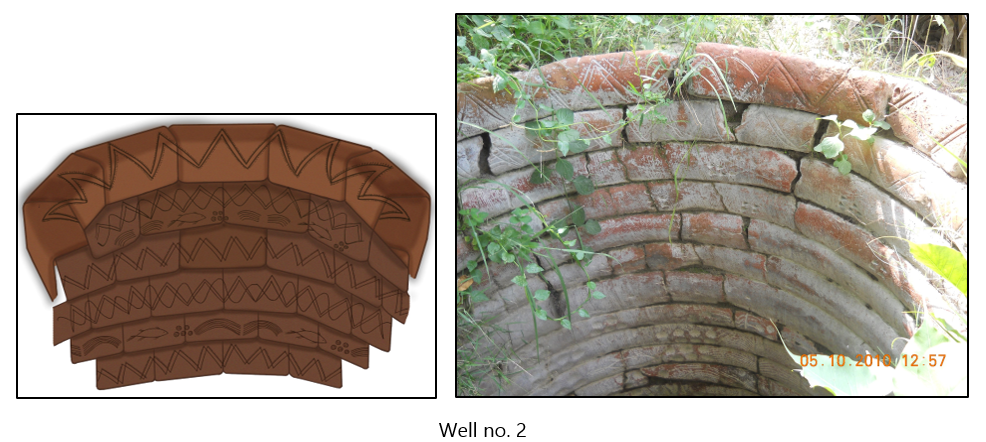
Well no. 2 shows similar double-lined triangles as well 1, however, here the triangles do not have circles underneath them. On a closer look we find rows of small dots over the top line and under the bottom line of the pattern. On the second row there are similar double-lined triangles but here they are overlapped by a wave pattern. This is an interesting motif that is not often repeated. Below this is a repetitive pattern consisting of five-lined wave, fish and circles ‘ladoos’ similar to well 1. The next line again has two lines of triangles on either side of which are small dots similar to the top most pattern.
- Barka Gaon (Total 8 Wells, 5 covered and 3 uncovered)
Barka Gaon which was called Bhandagam was a place of importance in early Buddhism. We have evidence of the Buddha giving various sermons to his disciples here. This points to this being an important place of congregation. Additionally, according to Jain tradition, Gautam Swami, the first Ganadhara of Lord Mahavira, is believed to have attained nirvana in Badgam. He is referred to in Jain Agamas as “Adimuni” (the first monk). The place of his nirvana in Badgam is still called “Garuniya”, and evidence suggests the presence of a circumambulatory path around it. [5]. The following cantos from the Mahaparinibbana sutta elaborate on the area’s Buddhist past.
Āyām’ Ānanda yena Bhaṇḍagāmo tenupasaṅkamissāmā.” ti
Come Ānanda let us approach Bhaṇḍagāma.”
“Evaṁ Bhante,” ti kho āyasmā Ānando Bhagavato paccassosi.
“Very well, reverend Sir,” venerable Ānanda replied to the Fortunate One.
Atha kho Bhagavā mahatā Bhikkhusaṅghena saddhiṁ yena Bhaṇḍagāmo tad-avasari.
Then the Fortunate One together with a great Community of monks arrived at Bhaṇḍagāma.
Tatra sudaṁ Bhagavā Bhaṇḍagāme viharati.
There the Fortunate One lived near Bhaṇḍagāma.
Tatra kho Bhagavā bhikkhū āmantesi:
There the Fortunate One said this to the monks
“Catunnaṁ, bhikkhave, dhammānaṁ ananubodhā appaṭivedhā
“Because of a lack of understanding and a lack of penetration, monks, of four things
evam-idaṁ dīgham-addhānaṁ sandhāvitaṁ saṁsaritaṁ mamañ-ceva tumhākañ-ca.
both you and I have been wandering and running along (in Saṁsāra) for a long time.
(Canto 27 verse 463-465)
Tatra pi sudaṁ Bhagavā Bhaṇḍagāme viharanto,
There also the Fortunate One, while living in Bhaṇḍagāma,
etad-eva bahulaṁ bhikkhūnaṁ Dhammiṁ kathaṁ karoti:
spoke frequently to the monks about the Teaching, (saying):
“Iti sīlaṁ, iti samādhi, iti paññā,
“Such is virtue, such is concentration, such is wisdom,
sīlaparibhāvito samādhi mahapphalo hoti mahānisaṁso,
when virtue is well-developed it yields great fruit and brings great advantages in regard to concentration,
samādhiparibhāvitā paññā mahapphalā hoti mahānisaṁsā,
when concentration is well-developed it yields great fruit and brings great advantages in regard to wisdom,
Paññāparibhāvitaṁ cittaṁ sammad-eva āsavehi vimuccati,
when wisdom is well-developed the mind is completely liberated from the pollutants,
seyyathīdaṁ: kāmāsavā bhavāsavā avijjāsavā.” ti
that is to say: the pollutant of sensuality, the pollutant of (craving for) continued existence, the pollutant of ignorance.”[6]
(Canto 27 verse 475-476)
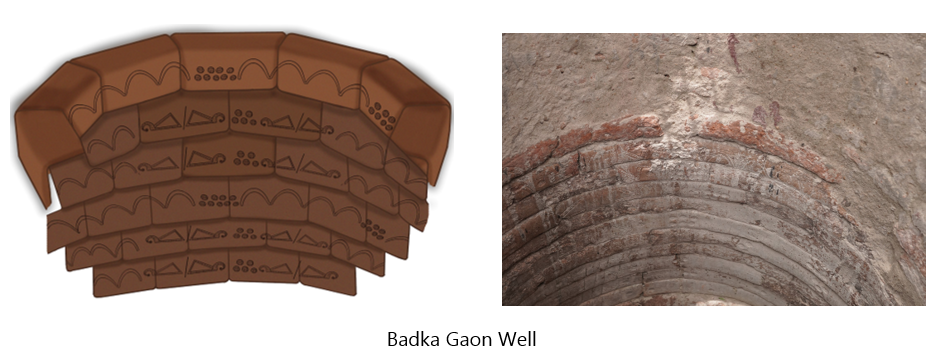
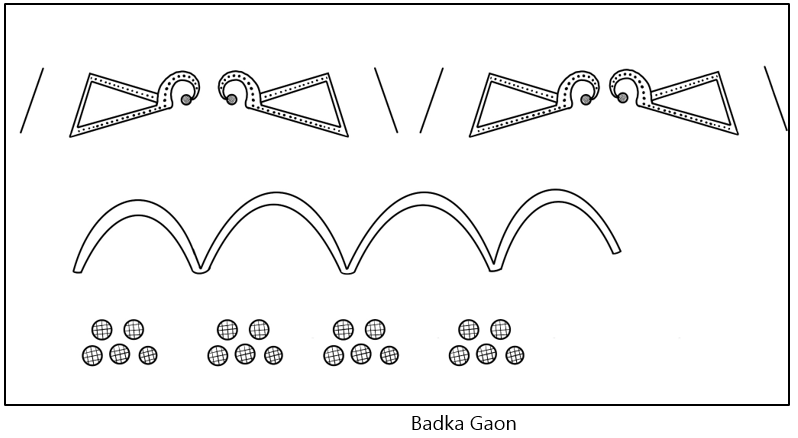
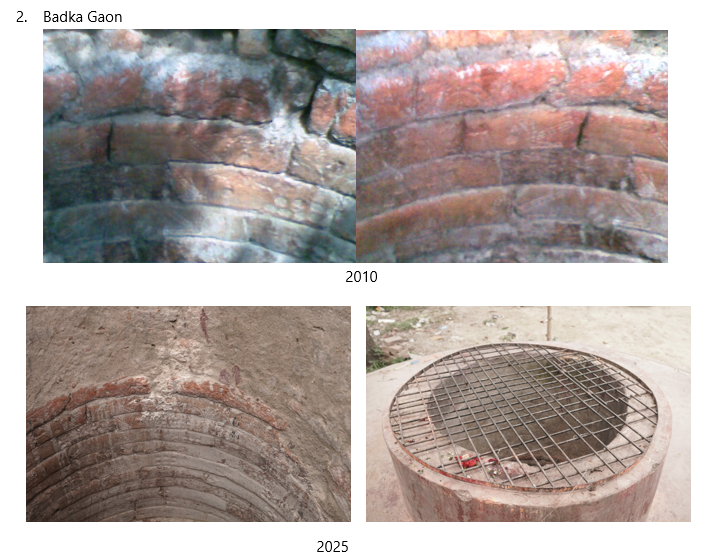
The well of Badka gaon is in a dilapidated condition. There is a clear indication of patterns followed throughout the interior of the well but a good amount of these are lost over time. From what survives we can ascertain that the circular motif ‘ladoo’ remains the same. In the first row we see 4 joined double lined arches interspersed by two rows of circles ‘ladoos’. In the second row these arches are interspersed by ‘ladoos’ together with two elaborate triangular motifs with intricate carving on either side. Throughout the well this pattern is repeated.
- Belwar (3 wells)
Belwar, formerly known as Velugram or Beluva, is where the Buddha spent his final rainy retreat. Evidence of the same is found in the Mahaparinibbana canto 16. It appears that in ancient times, the area from Narson Lake to Tarson, as well as nearby places like Bihlarwara Govind, Bihlarwara Rupnath, Sauri Gopnath, Dwarkanathpur, and others, had a significant influence from Jain and Buddhist communities. Velubagram was known as a center for Buddhist monks’ spiritual practices and had significant connections with the spiritual and religious activities of that time.[7]
Atha kho Bhagavā Ambapālivane yathābhirantaṁ viharitvā,
Then the Fortunate One, after living near Ambapālī’s Wood for as long as he liked,
āyasmantaṁ Ānandaṁ āmantesi:
addressed venerable Ānanda, (saying):
“Āyām’ Ānanda yena Beluvagāmako tenupasaṅkamissāmā.” ti
“Come Ānanda let us approach the little village of Beluva.”
“Evaṁ Bhante,” ti kho āyasmā Ānando Bhagavato paccassosi.
“Very well, reverend Sir,” venerable Ānanda replied to the Fortunate One.
Atha kho Bhagavā mahatā bhikkhusaṅghena saddhiṁ
Then the Fortunate One together with a great Community of monks
yena Beluvagāmako tad-avasari.
arrived at the little village of Beluva.
Tatra sudaṁ Bhagavā Beluvagāmake viharati.
There the Fortunate One lived near the little village of Beluva.
Tatra kho Bhagavā bhikkhū āmantesi:
There the Fortunate One addressed the monks, (saying):
“Etha tumhe bhikkhave samantā Vesāliṁ
“Go, monks, and undertake the Rains Retreat in the vicinity of Vesālī
yathāmittaṁ yathāsandiṭṭhaṁ yathāsambhattaṁ Vassaṁ upetha,
(living) like friends, like companions, like comrades,
ahaṁ pana idheva Beluvagāmake Vassaṁ upagacchāmī.” ti
and I will spend the Rains Retreat right here at the little village of Beluva.”
“Evaṁ Bhante,” ti kho te bhikkhū
“Very well, reverend Sir,” and those monks,
Bhagavato paṭissutvā, samantā Vesāliṁ
after replying to the Fortunate One, undertook the Rains Retreat in the vicinity of Vesālī
yathāmittaṁ yathāsandiṭṭhaṁ yathāsambhattaṁ Vassaṁ upagacchiṁsu.
(living) like friends, like companions, like comrades.
Bhagavā pana tattheva Beluvagāmake Vassaṁ upagacchi.
But the Fortunate One spent the Rains Retreat right there at the little village of Beluva.
Atha kho Bhagavato Vassūpagatassa kharo ābādho uppajji,
Then while dwelling for the Rains Retreat, a heavy affliction arose for the Fortunate One,
bāḷhā vedanā vattanti maraṇantikā.
and continued with strong and death-like feelings.
(Canto 16: Verses 281-286[8])
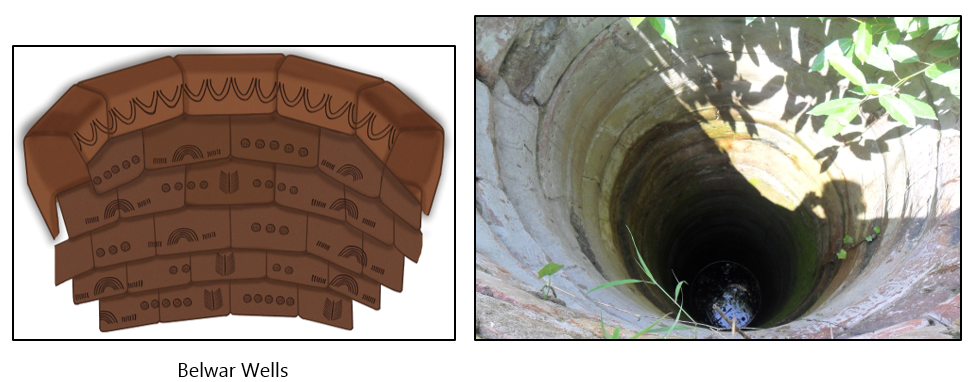
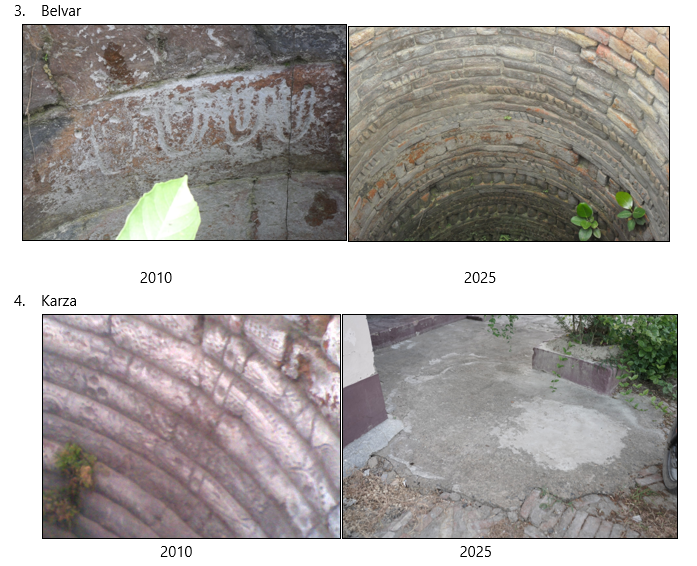
The well in Belwar also survives in poor condition, but it introduces new design elements. The first row consists of a double-lined “U” pattern. Below this, three alternating motifs appear: five-lined arches with small side lines, followed by five “Laddu” circles, and a rudimentary plant motif, possibly depicting wheat stalks or leaves, symbolizing fertility.
- Karja (1 well – now covered)
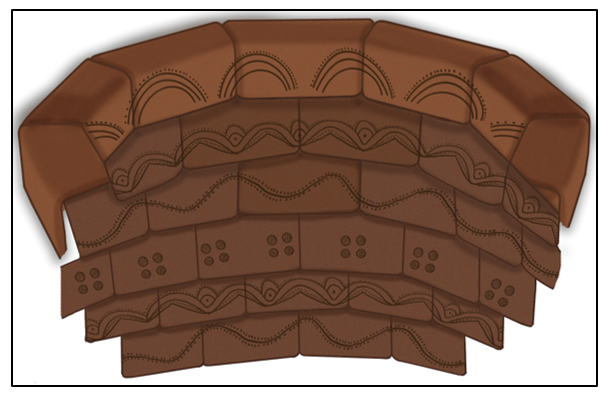
Karja, historically referred to as the Karyalaya (Headquarters) of the Vajjis, is another site where a carved well has been found. Ramnagar Tonk, through which Shri Rama is believed to have passed on his way to Janakpur to marry Sita, also contains such wells. The presence of these unique wells in villages with ancient historical significance and ties to both Buddha and Rama suggests their antiquity and cultural importance.
- Ramnagar Tonk (1 well)
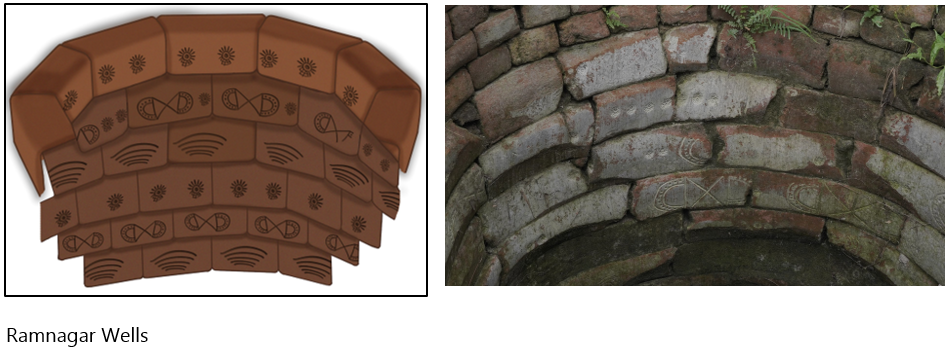
Ramnagar Tonk, located in West Champaran, is historically linked to Shri Rama’s journey to Janakpur. This connection reinforces the idea that these wells are not only ancient but also strategically and religiously significant. The well in Ramnagar Tonk exhibits a diverse range of motifs, although it survives in poor condition. The existing patterns, however, provide insights for potential reconstruction. The first row features circular designs with small protruding lines, possibly representing the sun. The second row showcases mirrored triangular shapes with double-lined semicircles at their ends—an entirely unique pattern among the region’s wells. Between these patterns, groups of three circles are carved. The next row follows a similar arrangement, with five parallel lines forming an intricate design.
The distinctive carved wells of the Vajjika region, with their elaborate motifs and historical connections, serve as a remarkable testament to the artistic and cultural heritage of ancient India. Despite their current state of neglect, these wells remain an invaluable part of the region’s history and deserve further study and preservation.
Motifs
These wells are dominantly carved with simplified motifs of leaves and creepers, geometrical patterns like criss cross, and running triangular lines on the hem of the wells. Ornamented circular motifs locally called Laddu motifs, rhythmic lines and decorative patterns.
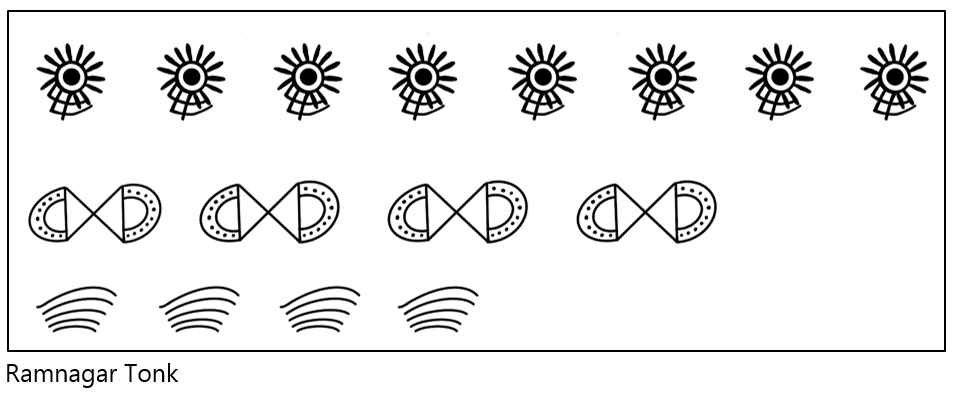
The symbolism of these motifs is varied and culturally significant. For instance:
Fish – the fish motif holds profound meaning across numerous folk cultures and traditions. It is widely regarded as a universal symbol of fertility and purity. The graceful, flowing form of the fish evokes notions of beauty and vitality, often interpreted as a representation of the life force, regeneration, reincarnation, and as a protective charm against the evil eye.
In Indian mythology, the fish is also associated with divine manifestations, notably as the Matsya avatar, an incarnation of the god Vishnu, and is linked with the deity Varuna. Within the textile tradition of Nakshi Kantha, the fish emerges as one of the most frequently used and thoughtfully selected motifs. It is often depicted in water, emphasizing its symbolic association with purification, renewal, and the sustaining force of life.[9]
Circles – The circle is among the most ancient and enduring symbols in human visual culture, appearing as early as prehistoric cave paintings. Universally, the circle represents more than just the sun or the earth—it encapsulates the cosmos in its entirety. As a form without beginning or end, the circle signifies completeness, infinity, and unity. In symbolic terms, it has been associated with celestial bodies, the cyclical nature of time, and the metaphysical realms of existence. Its recurrence in artistic and ritual contexts underscores its role as a primal archetype in human consciousness and visual expression.[10]
Lines – Lines serve both structural and symbolic purposes in visual composition. They delineate space, highlight elements, and contribute to the aesthetic rhythm of an artwork. However, beyond their decorative role, lines also function as early tools of communication and temporal notation. When combined with dots and other forms, linear arrangements can be interpreted as rudimentary scripts—perhaps even precursors to written language. Conceptually, lines evoke abstract ideas such as boundaries, pathways, transitions, and temporal progression, making them essential to both artistic form and symbolic thought.
Waves – Wave motifs, while decorative, carry rich metaphorical significance. They often represent elemental forces such as water, air, or fire, and by extension, the dynamic, flowing nature of life itself. In tandem with circles, waves suggest cyclical movement and the eternal rhythm of the universe. Their use in spiritual and ritualistic contexts further affirms their symbolic depth, evoking notions of continuity, impermanence, and transformation. Understanding wave patterns in folk and ritual art requires engagement with these broader cosmological and philosophical ideas.
Plant/grain – The motif of grain, particularly stylized depictions resembling wheat stalks, is deeply rooted in the cultural imagination and agricultural foundations of human society. Agriculture, as the earliest mode of subsistence, rendered the grain a symbol of sustenance, fertility, and survival. It signifies both material nourishment and the cyclical rhythms of life, aligning with seasonal change and human labor. As such, the grain motif transcends its literal meaning to become a cultural emblem of prosperity and continuity.
Sun – The sun holds a place of exceptional importance across cultures as a divine and life-giving force. In Indian traditions, it is venerated in festivals such as Chhath Puja, Bhai Duj, and Satyanarayan Puja. Visually, it is often rendered as a radiant circle with emanating rays, a form found in ancient rock art such as the Sun with seven rays at Singhanpur in Raigarh—one of the oldest known depictions of sun worship.
In Hinduism, the sun (Surya) is not only a deity but also the visible source of light, energy, and time. He is described in scriptures such as the Rig Veda and Gayatri Mantra as the “giver of light and life” (Savitur), riding a chariot drawn by seven horses symbolizing the seven colors of light. The Rig Veda further states, “Surya is the Soul, both of the moving and unmoving beings,” affirming the sun’s integral connection to all life forms.[11]
The sun’s symbolism extends into yogic and spiritual practices as well; the Surya Namaskar or Sun Salutation is both a physical and spiritual exercise honoring this celestial force. As one of the only divine forms visible to the human eye, the sun is revered not only for its physical power but also for its metaphysical and spiritual presence in human life.[12]
Conservation
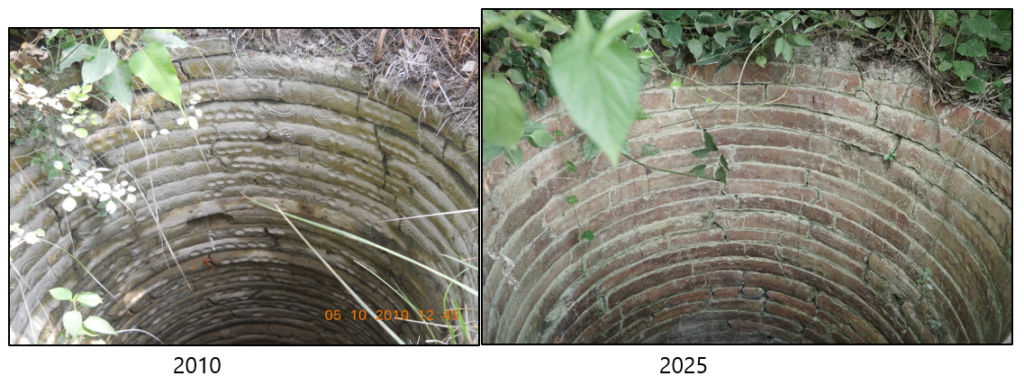
The wells found in the region remain in a dilapidated condition in urgent need of documentation and conservation efforts. Many wells unfortunately have been covered by the people of the area in efforts to preserve them. The wells which have remained undisturbed have been covered in thick foliage.
Urgent efforts need to be made to preserve the wells that still survive. In conditions where the carvings are still present there is still an enormous amount of preservation that can be undertaken. A continuous study of the area together with an understanding of the religious dynamism of the area point out the historic significance of the area. The wells in all probability marked these important areas and have to be preserved for posterity.
The various conditions of the wells are as under:
- Lakhmipur Arar
Conclusion
Situated in villages that hold significant associations with Buddhism, Jainism, and Hinduism, these wells probably did not serve any utilitarian purposes but embodied sacred and symbolic functions. Through their intricate carvings—ranging from geometric patterns and vegetal motifs to figurative depictions such as fish and symbolic circular designs—these structures reveal a complex visual language that intertwines local artisanal traditions with broader spiritual narratives.
The detailed examination of wells from Lakshmipur Arar, Barka Gaon, Belwar, Karja, and Ramnagar Tonk underscores a continuity of stylistic choices as well as localized innovations, suggesting a shared cultural matrix shaped by diverse influences. Despite the deterioration and neglect many of these wells have suffered, the surviving elements still allow for meaningful art historical and archaeological interpretations. This study highlights the importance of preserving these vernacular monuments not only as functional relics of the past but as living testimonies to the region’s layered heritage. Further documentation, conservation efforts, and scholarly attention are essential to safeguard these silent yet eloquent witnesses of India’s ancient artistic legacy.
Acknowledgement
The research paper is completed under the research project granted by Indian Council of Social Science Research (ICSSR) titled, “Unveiling Indigenous Artistic Traditions: Documentation and Iconographic Analysis of the Manuscript Paintings and Motifs of Archaeological Sites from Vajjikanchal Region in Bihar” at National Institute of Fashion Technology, Delhi.
References, Notes and Bibliography:
- Abbas, Riza.”An Assessment of Circular Motifs and Their Diverse Forms Occurring in Indian Rock Art”, Heritage: Journal of Multidisciplinary Studies in Archaeology. December, 2020.
- Bharadwaj, Kali. Last Days of The Buddha, The Maha Parinibbana Sutta. Buddhist Publication Society: Srilanka, 1964.
- Chaudhary, Suchhudananda. The Search for Ksheer Sagar. Muzaffarpur:Girija-Chandrika Publications.
- https://ancient-buddhist-texts.net/Texts-and-Translations/Mahaparinibbanasuttam/index.htm.
- NCERT. “Folk Art Secondary Course 1 Theory 244,” https://nios.ac.in/media/documents/244_Folk_art/Theory_Folk-Art-whole.pdf.
- Veenu, Katare Charu, Sharma, Renu Bala. “Symbolic motifs in traditional Indian Textile and Embroideries” International Journal of Research in Economics and Social Sciences. March, 2016. ISSN: 2249-7382.
- Wynne, Alexander. The Origin of Buddhist Meditation. United Kingdom: Taylor & Francis, 2007.
[1] Kali Bhardwaj, The Mahaparinibbana Sutta Last Days of the Buddha, canto 33-43, 52-55
[2] Sichhidanand Chaudhary, The Search for Ksheer Sagar, 43
[3] Alexander Wynne, The Origin of Buddhist Meditation. 8
[4] Sichhidanand Chaudhary, The Search for Ksheer Sagar, 78
[5] Sichhidanand Chaudhary, The Search for Ksheer Sagar, 92
[6] “27: The Four Noble Things,” Ancient-buddhist-texts.net, 2025, https://ancient-buddhist-texts.net/Texts-and-Translations/Mahaparinibbanasuttam/27-Noble-Things.htm.
[7] Sichhidanand Chaudhary, The Search for Ksheer Sagar, 125
[8] “27: The Four Noble Things,” Ancient-buddhist-texts.net, 2025, https://ancient-buddhist-texts.net/Texts-and-Translations/Mahaparinibbanasuttam/27-Noble-Things.htm.
[9] Veenu, Charu Katare, Renu Bala Sharma, “Symbolic motifs in traditional Indian Textile and Embroideries” 2016 IJREES journal, 5
[10] Riza Abbas, An Assessment of Circular Motifs and Their Diverse Forms Occurring in Indian Rock Art, 6-7
[11] NCERT. “Folk Art Secondary Course 1 Theory 244,” 52-59
[12] Veenu, Charu Katare, Renu Bala Sharma, “Symbolic motifs in traditional Indian Textile and Embroideries” 2016 IJREES journal