
| Kinjal Jadeja Assistant Professor Nootan Ayurveda College & Research Center Sankalchand Patel University, Visnagar Ahmedabad (Gujarat) India | Dr. Satyjitsinh Zala Assistant Professor & Research Co-Ordinator LYU Ahmedabad (Gujarat) India | Dr. Abhijeetsinh Jadeja Professor & Principal B.C.A. Sankalchand Patel University, Visnagar Ahmedabad (Gujarat) India |
Abstract
The Mind Sound Resonance Technique (MSRT) represents a paradigmatic convergence of classical Vedic soteriology and contemporary clinical psychophysiology. Developed by the Swami Vivekananda Yoga Anusandhana Samsthana (S-VYASA), MSRT operationalizes the ancient yogic science of Nadanusandhana (exploration of internal sound) into a standardized therapeutic intervention. This report provides a comprehensive, expert-level examination of MSRT, deconstructing its theoretical foundations in the Pancha Kosha (five sheaths) model, its ritualistic architecture grounded in the four levels of Vak (speech), and its empirical efficacy in modulating autonomic and cognitive functions. By synthesizing data from randomized controlled trials with deep philosophical exegesis, this paper argues that MSRT functions not merely as a relaxation technique, but as a structured Antar Yaga (internal ritual) that systematically resolves the Chit-Vṛttis (mental fluctuations) responsible for psychosomatic distress. The analysis integrates quantitative data on Heart Rate Variability (HRV), cortical execution functions, and endocrine markers (cortisol) to demonstrate how MSRT bridges the metaphysical goal of Moksha (liberation) with the therapeutic necessity of stress regulation.
Keywords: Mind Sound Resonance Technique (MSRT), Nadanusandhana, Pancha Kosha, Adhija Vyadhi, Autonomic Nervous System, Heart Rate Variability (HRV), Cortisol, Stroop Task, Vagal Tone, Gamma Coherence, Four Levels of Vak, Nada Brahman, Spanda, Antar Yaga, Psychosomatic Stress.
1. Introduction: The Crisis of Fragmentation and the Promise of Resonance
In the landscape of modern mental health, the prevalence of psychosomatic disorders points to a fundamental fragmentation of the human psyche—a dissonance between the cognitive, emotional, and physiological domains. Contemporary psychotherapy often addresses these domains in isolation. In contrast, the Indic tradition posits a unified field of consciousness (Chit) where mind and body are continuum manifestations of a subtle vibratory substrate (Spanda).
The Mind Sound Resonance Technique (MSRT) emerges from this holistic paradigm. Unlike physicalist approaches to yoga that prioritize Asana (posture), MSRT prioritizes Nada (sound) as the primary vehicle for traversing the layers of consciousness. Grounded in the Mandukya Upanishad and the Spanda Karikas of Kashmir Shaivism, MSRT is designed to generate a “forcing function” of resonance that entrains the chaotic frequencies of a stressed mind into a coherent harmonic state.
This report seeks to rigorously examine MSRT as an applied psychospiritual model. It aims to answer: How does the ritualized progression from audible sound (Ahata) to mental silence (Anahata) modulate the autonomic nervous system? What are the neurocognitive correlates of this sonic internalization? And how does the Indic conception of “sound as consciousness” offer a novel framework for understanding the therapeutic efficacy of mantra?
- Theoretical Framework: The Ontology of Sound in Indic Psychology
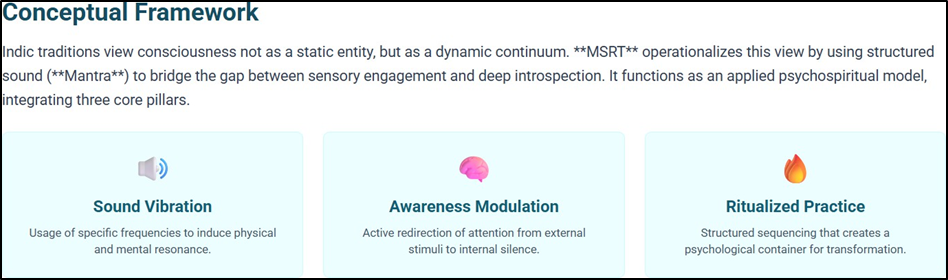
To understand MSRT, one must first suspend the materialist view of sound as a mere mechanical wave and adopt the Indic view of sound as an ontological power (Shakti).
- Nada Brahman: The Sonic Absolute
In Vedic cosmology, the universe evolves from a primordial vibration known as Nada Brahman. This is not sound that travels through air, but the creative impulse of consciousness itself. The Maitri Upanishad distinguishes between two types of Brahman: Shabda Brahman (Sound Absolute) and Ashabda Brahman (Silent Absolute). MSRT is a technology of moving from Shabda to Ashabda. By focusing on the gross manifestation of sound, the practitioner can trace the vibration back to its source in silence.
- The Pancha Kosha Model: The Etiology of Stress
MSRT’s therapeutic logic is derived from the Pancha Kosha (Five Sheaths) model found in the Taittiriya Upanishad. This model maps the human experience across five concentric layers :
- Annamaya Kosha (Physical Sheath): The gross body, sustained by food.
- Pranamaya Kosha (Energy Sheath): The vital force, governed by breath.
- Manomaya Kosha (Mental Sheath): The seat of emotion, memory, and sensory processing.
- Vijnanamaya Kosha (Wisdom Sheath): The intellect and discriminative faculty.
- Anandamaya Kosha (Bliss Sheath): The core of unconditional joy and homeostasis.
According to the Yoga Vasistha, modern stress disorders are classified as Adhija Vyadhi (stress-born diseases). The pathology begins in the Manomaya Kosha as Adhi—a speed or agitation of thoughts (Vega). This mental turbulence disturbs the Prana (energy flow) in the Pranamaya Kosha, leading to autonomic dysregulation. Over time, this energetic imbalance manifests in the Annamaya Kosha as structural or functional disease (Vyadhi).
MSRT targets the Manomaya Kosha. It does not attempt to “fix” the physical body directly. Instead, it uses resonance to soothe the agitation of the mind. By reducing the speed of thoughts (Vṛtti-Nirodha), the technique harmonizes the Prana, which in turn restores homeostatic balance to the physical body. This “top-down” regulation is the hallmark of Yoga Therapy.
2.3 The Linguistics of Liberation: Four Levels of Vak
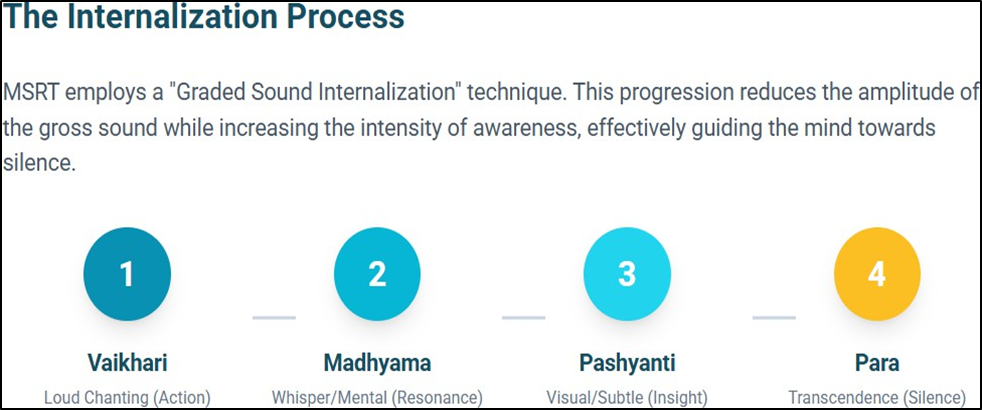
A critical, often overlooked aspect of MSRT is its reliance on the Tantric theory of Vak (Speech). Consciousness expresses itself through sound in four descending grades of subtlety. MSRT guides the practitioner in ascending this ladder :
- Vaikharī (Articulate Speech): This is the grossest level of sound, spoken by the tongue and heard by the ear. It corresponds to the waking state (Jagrat). In MSRT, this is the phase of loud chanting (Ahata).
- Madhyamā (Intermediate Speech): This is the level of mental thought and internal dialogue. It resides in the subtle body and corresponds to the dream state (Svapna). In MSRT, this is the phase of mental chanting (Anahata).
- Pashyantī (Visible Speech): This is the level of intuitive “seeing” where sound and meaning are undifferentiated. It is a state of deep insight
- , corresponding to deep sleep (Sushupti) or the causal body. In MSRT, this corresponds to the deep resonance where the mantra is felt as a unified wave of consciousness.
- Parā (Transcendental Speech): This is the level of pure potentiality—the silence before the sound arises. It corresponds to the Turiya (fourth) state. In MSRT, this is the final silence after the resolution of the mantra.
The operational success of MSRT lies in its ability to transition the practitioner from the noisy, fragmented world of Vaikharī to the unified silence of Parā.
2.4 Spanda: The Doctrine of Vibration
Kashmir Shaivism contributes the concept of Spanda—the divine pulsation. The Spanda Karikas teach that the essential nature of the Self is not static but dynamic—a throb of pure awareness. Psychological suffering arises when we lose touch with this central pulse and identify with the peripheral noise of the mind. MSRT uses the mantra as a sympathetic resonator. By introducing a rhythmic, potent sound vibration (like Om), the practice re-aligns the individual’s mental vibration with the cosmic Spanda, dissolving the rigid structures of the ego.
3. Deconstructing the Ritual: The MSRT Protocol
MSRT is structured as a contemporary Antar Yaga (internal sacrifice). It follows a precise ritual sequencing (Vinyasa) that mirrors traditional Vedic rites: Sankalpa (Intention) $\rightarrow$ Shuddhi (Purification) $\rightarrow$ Avahana (Invocation) $\rightarrow$ Visarjana (Merging).
3.1 The Eight-Step Protocol Analysis
The standard clinical protocol of MSRT typically lasts 30-45 minutes and involves the following stages :
| Step | Sanskrit Term | Description & Mechanism | Indic Psychological Function |
| 1 | Prarthana | Opening Prayer: Usually “Om Sahana Vavatu” or similar. | Creates a Temenos (sacred space). Initiates Bhavana (attitude) of surrender. |
| 2 | A-U-M Resonance | Ahata-Anahata of A-U-M: Chanting ‘A’, ‘U’, ‘M’ aloud, then mentally. | Sonic Scanning: ‘A’ resonates in the lower body (waking state); ‘U’ in the middle (dream state); ‘M’ in the head (deep sleep). Integrates the fragmented self. |
| 3 | Mantra Japa | Ahata-Anahata of Mahamrityunjaya: Chanting the long mantra aloud, then mentally. | Vagal Stimulation: Long exhalations trigger the baroreceptor reflex. The complex meter demands high cognitive focus (Dharana). |
| 4 | Anahata AUM | Mental AUM Resonance: Repeating ‘Om’ mentally, feeling the wave from navel to head. | Internalization: Shifts focus from the sensory organ (tongue) to the mind (Manas). Moves from Vaikharī to Madhyamā. |
| 5 | Ajapa Japa | Involuntary Repetition: The mantra repeats itself effortlessly. | Flow State: Transition from effortful attention (Dharana) to effortless flow (Dhyana). |
| 6 | Mouna | Silence: Cessation of all mental sound. | Nirodha: The state of Parā. The resonance dissolves into the source. Pure Awareness. |
| 7 | Sankalpa | Resolve: Affirmation planted in the deep silence. | Reprogramming: Utilizing the plasticity of the deep alpha/theta state to imprint positive volition (Iccha Shakti). |
| 8 | Shanti Path | Closing Prayer: “Sarve Bhavantu Sukhinah”. | Re-externalization: Expanding the internal peace to the external environment. Grounding. |
3.2 The Specific Mantras: Semantics and Somatics
The choice of mantras in MSRT is critical to its psychodynamic effect.
The Pranava (AUM)
AUM acts as the sonic gestalt. In the Mandukya Upanishad, ‘A’ represents the physical world, ‘U’ the mental world, and ‘M’ the causal world. By chanting them in sequence, the practitioner experientially traverses these planes. The silence following the ‘M’ is the Turiya, the Self. This practice systematically dismantles the practitioner’s identification with the body and mind, offering a momentary experience of transcendence.
The Mahamrityunjaya Mantra
This mantra, dedicated to Rudra (Shiva), is the “Great Death-Conquering Mantra.” Text: Oṁ tryambakaṁ yajāmahe sugandhiṁ puṣṭi-vardhanam | urvārukam iva bandhanān mṛtyor mukṣīya māmṛtāt || Psychological Significance: The mantra contains a powerful metaphor: “Liberate me from death (attachment) effortlessly, just as a ripe cucumber falls from the vine.” This addresses Abhinivesha (fear of death/extinction), which Patanjali identifies as the deepest source of existential anxiety. By repeating this mantra, the practitioner internalizes a script of “effortless letting go.” The mantra frames liberation not as a violent rupture, but as a natural ripening. This cognitive reframing helps reduce the subconscious hyper-vigilance associated with anxiety disorders.
4. Mechanisms of Action: The Psychophysiology of Resonance
How does a ritual of sound translate into measurable health outcomes? The mechanisms can be understood through the intersection of neurobiology and physics.
4.1 The “Sanskrit Effect” and Neuroplasticity
Neuroimaging research on Vedic chanters has documented the “Sanskrit Effect”—a significant increase in grey matter density in the right hippocampus and temporal cortex. These areas are associated with spatial memory, sound processing, and pattern recognition. The rigorous memorization and precise articulation required in MSRT engage the Prefrontal Cortex (PFC) (executive control) and the Hippocampus (memory encoding). The repetitive nature of the chanting induces Long-Term Potentiation (LTP), strengthening the neural circuits involved in attention and emotional regulation.
4.2 Vagal Tone and Respiratory Sinus Arrhythmia (RSA)
MSRT is a potent vagal nerve stimulator. The chanting of long mantras like Mahamrityunjaya necessitates a prolonged exhalation phase. Physiologically, exhalation is linked to parasympathetic activation.
- Mechanism: Extended exhalation increases intrathoracic pressure, stimulating the baroreceptors. This signals the brainstem to lower heart rate and blood pressure via the vagus nerve.
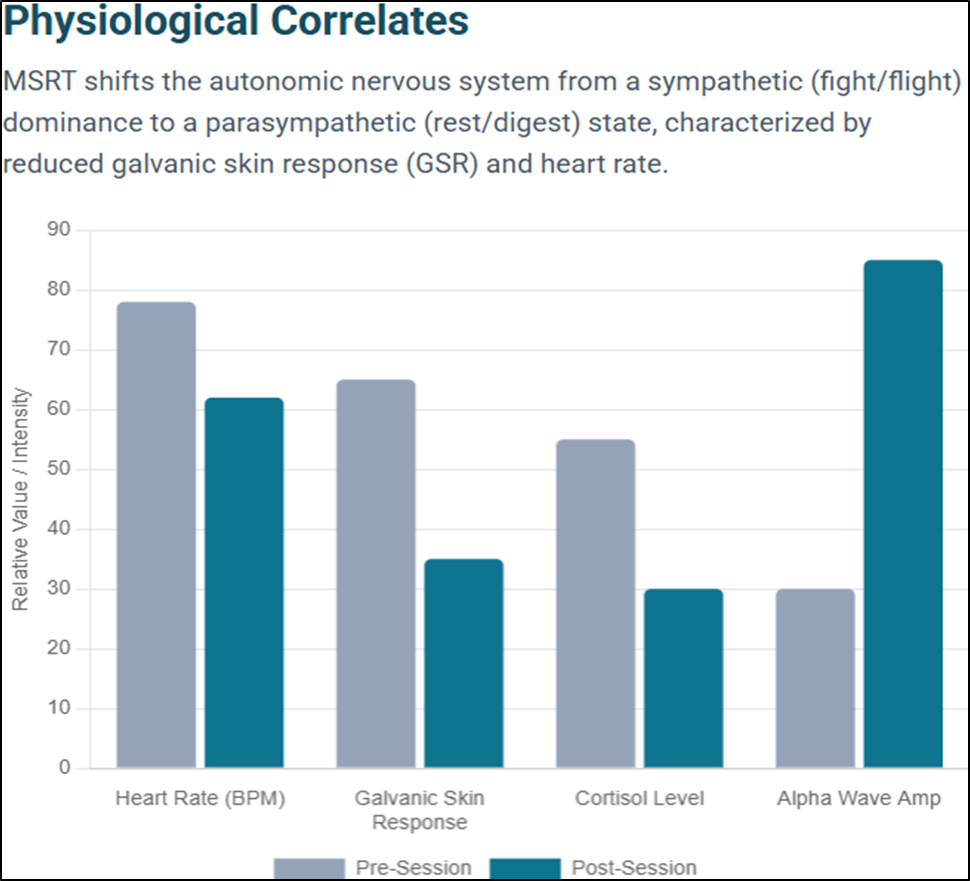
- Result: This shift from Sympathetic (Fight/Flight) to Parasympathetic (Rest/Digest) dominance is quantifiable through Heart Rate Variability (HRV) metrics, specifically an increase in the High-Frequency (HF) component and RMSSD.
4.3 Gamma Coherence and Neural Binding
EEG studies on MSRT and similar mantra practices have observed an increase in Gamma wave (30-100 Hz) coherence. Gamma waves are associated with the “binding problem”—how the brain integrates disparate sensory inputs (sight, sound, thought) into a unified moment of consciousness. In the Pancha Kosha model, mental illness is often a state of fragmentation. The induction of high-amplitude Gamma synchrony suggests that MSRT facilitates a state of high-level neural integration, corresponding to the subjective experience of “oneness” or Samadhi.
4.4 Sensory Gating and Thalamic Filtering
The transition from Ahata (external sound) to Anahata (internal sound) effectively trains the brain’s sensory gating mechanisms. By focusing intense attention on an internally generated stimulus, the thalamus is inhibited from relaying external sensory data to the cortex. This explains the improvement in selective attention tasks: the brain becomes more efficient at filtering out distractors (noise) to focus on the signal.
5. Empirical Evidence: Clinical Efficacy of MSRT
The efficacy of MSRT has been validated through various Randomized Controlled Trials (RCTs) targeting cognitive, autonomic, and endocrine variables.
5.1 Cognitive Enhancement: The Stroop Task
A definitive study on college students assessed the impact of MSRT on executive function using the Stroop Color-Word Task, a gold-standard measure of inhibitory control.
Table 1: Effect of MSRT on Reaction Time (RT) in Stroop Task (n=20)
| Task Condition | MSRT Pre- Test (ms) | MSRT Post-Test (ms) | Mean Difference (ms) | P- Value | Significance |
| Neutral | 649.96 ± 67.34 | 613.92 ± 66.91 | -36.04 | 0.002 | Significant |
| Congruent | 624.38 ± 88.03 | 575.99 ± 80.30 | -48.39 | 0.003 | Significant |
| Incongruent | 745.50 ± 77.35 | 653.39 ± 84.92 | -92.11 | 0.000 | Highly Significant |
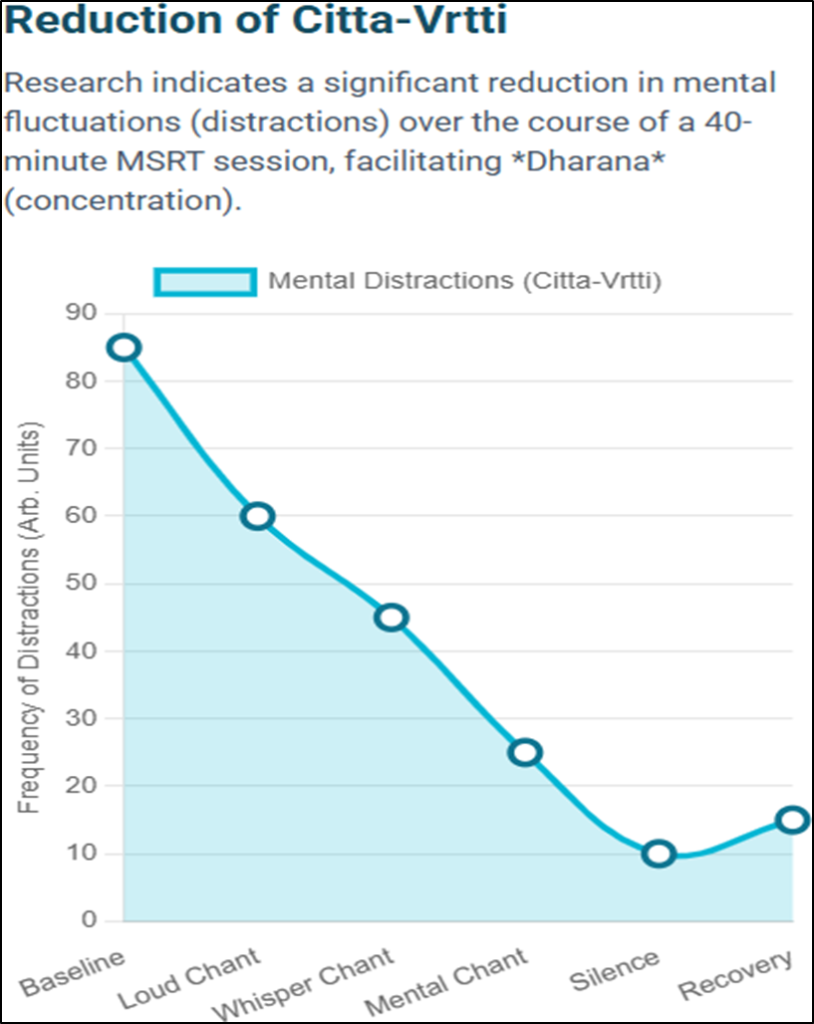
Analysis: The most profound improvement (-92.11 ms) occurred in the Incongruent task, which requires the subject to inhibit the automatic impulse to read the word and instead name the ink color. This indicates that MSRT significantly enhances Inhibitory Control, a key executive function housed in the Prefrontal Cortex. The practice of inhibiting external thoughts to focus on the mantra likely transfers to this cognitive skill.
5.2 Autonomic Regulation: Heart Rate Variability (HRV)
HRV analysis provides a window into the autonomic balance. A study comparing MSRT with Supine Rest (SR) demonstrated superior autonomic regulation in the MSRT group.
Table 2: Heart Rate Variability (HRV) Outcomes
| Parameter | Physiological Correlate | Pre-Intervention | Post-Intervention | Trend | P- Value |
| RMSSD (ms) | Parasympathetic (Vagal) Tone | 106.64 | 148.88 | Increase | < 0.001 |
| LFnu | Sympathetic Modulation | 52.24 | 47.81 | Decrease | < 0.01 |
| HFnu | Parasympathetic Modulation | 47.74 | 52.74 | Increase | < 0.05 |
| LF/HF Ratio | Sympathovagal Balance | 1.75 | 1.45 | Decrease | — |
Analysis: The significant increase in RMSSD (Root Mean Square of Successive Differences) confirms that MSRT induces a profound state of physiological relaxation that is distinct from mere rest. The shift in the LF/HF ratio towards the HF (High Frequency) band indicates a dominance of the parasympathetic system, which is crucial for recovery, digestion, and immune function.
5.3 Endocrine Markers: Cortisol and Stress
Chronic stress is biologically characterized by elevated levels of serum cortisol. MSRT has been shown to dampen the Hypothalamic-Pituitary-Adrenal (HPA) axis activity.
Table 3: Effect of MSRT on Serum Cortisol and Perceived Stress
| Variable | Pre-Test Mean | Post-Test Mean | t-value | P-Value |
| Serum Cortisol ($\mu$g/dL) | 7.80 ± 2.69 | 6.87 ± 2.67 | 7.896 | 0.001 |
| Variable | Pre-Test Mean | Post-Test Mean | t-value | P-Value |
| PSS Score (Perceived Stress) | 23.50 ± 3.27 | 19.50 ± 2.89 | 7.932 | 0.001 |
Analysis: The reduction in cortisol correlates with the subjective reduction in Perceived Stress Scale (PSS) scores. This biological validation supports the Indic theory that resolving mental agitation (Adhi) leads to physical homeostasis (Vyadhi-Nirodha).
5.4 Psychological and Sleep Outcomes
In a study of 100 IT professionals, a demographic prone to burnout, MSRT demonstrated remarkable efficacy in improving sleep quality and reducing anxiety.
Table 4: Psychometric Outcomes in IT Professionals
| Variable | Pre-Test | Post-Test | % Improvement | P-Value |
| Total Mood Disturbance | 25.87 ± 31.08 | 4.04 ± 16.89 | 84.38% | 0.000 |
| Global PSQI (Sleep Quality) | 2.95 ± 2.8 | 1.24 ± 1.54 | 57.9% | 0.000 |
| State Anxiety | 35.00 ± 7.55 | 26.91 ± 5.61 | 23.11% | 0.000 |
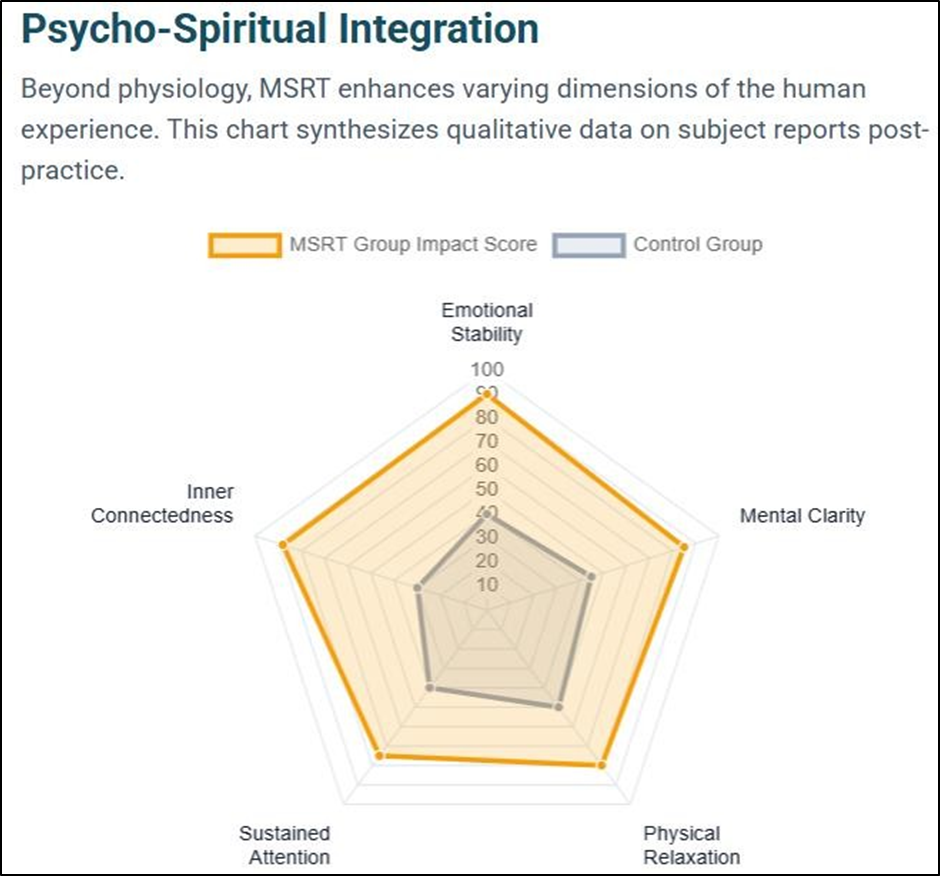
Analysis: The 84% reduction in mood disturbance is staggering and suggests that MSRT may be particularly effective for “high-functioning” anxiety—where cognitive noise disrupts sleep and mood despite external functionality. The “deep rest” of MSRT (Step 6: Silence) appears to compensate for the sleep debt accumulated by a hyper-aroused mind.
6. Discussion: MSRT as Contemporary Antar Yaga
The data presented invites a re-evaluation of mantra not as “religious chanting” but as a sophisticated acoustic technology for neural regulation. MSRT functions as a modern Antar Yaga (Internal Sacrifice).
In the traditional Vedic Yajna, physical substances (ghee, wood) are offered into a physical fire to propitiate deities. In the Antar Yaga of MSRT:
- The Fire (Agni) is the resonance of the mantra.
- The Offering (Ahuti) is the stream of chaotic thoughts (Vṛttis).
- The Deity (Devata) is the silence of the Self (Atman).
- The Fruit (Phala) is not material gain, but Prasada (Clarity/Tranquility).
This internalization is crucial. While physical relaxation (supine rest) drops heart rate, it does not necessarily organize the mind. The “monkey mind” continues to wander. MSRT engages the mind actively through resonance (Dharana) before leading it to silence (Dhyana). This active engagement prevents the mind from drifting into worry or sleep, maintaining a state of “Restful Alertness” characteristic of high-level meditation states.
Furthermore, MSRT’s efficacy in the “Incongruent” Stroop task suggests it builds “Mental Hardiness.” It does not just relax the user; it trains the user to withstand cognitive conflict. This aligns with the Yogic goal of Titiksha—the endurance of opposites (heat/cold, pleasure/pain) without mental agitation.
6.1 Clinical Implications
For modern clinicians, MSRT offers a standardized, non-invasive intervention for conditions characterized by autonomic hyper-arousal and cognitive fragmentation, such as Generalized Anxiety Disorder (GAD), Insomnia, and Hypertension. Its structured nature (unlike open-ended mindfulness) makes it accessible to novices who struggle to “just sit” in silence. The sonic component provides a tangible anchor for the anxious mind.
7. Conclusion
From an Indic psychological standpoint, the Mind Sound Resonance Technique is a bridge between the ancient and the modern. It validates the Upanishadic insight that Manas (Mind) is merely a collection of vibrations, and that by changing the vibration, one changes the mind.
The empirical evidence is robust: MSRT reduces cortisol, enhances heart rate variability, and sharpens executive inhibitory control. But beyond these metrics, it offers a structured methodology for Self-realization—the transition from the noisy, reactive self to the resonant, witnessing self. In an era defined by distraction and dissonance, MSRT offers a scientifically validated path back to resonance, reclaiming the “Sound of Silence” as the foundation of mental health.
Key Terminology
- Adhi-Vyadhi: The concept that physical disease (Vyadhi) originates from mental agitation (Adhi).
- Ahata/Anahata: Struck (external) vs. Unstruck (internal) sound.
- Antar Yaga: Internal ritual/sacrifice.
- Manomaya Kosha: The mental sheath of the personality.
- Nadanusandhana: The practice of meditating on internal sound.
- Spanda: The primordial vibration of consciousness.
- Vaikharī/Parā: The grossest and subtlest levels of speech.
References, Notes and Bibliography:
- Anusuya, U. S., Mohanty, S., & Saoji, A. A. (2021). Effect of Mind Sound Resonance Technique (MSRT—A yoga-based relaxation technique) on psychological variables and cognition in school children: A randomized controlled trial. Complementary Therapies in Medicine, 56, 102606. https://doi.org/10.1016/j.ctim.2020.102606
- Mohanty, S. K., Singh, A. K., Mohanty, S. S., Dwivedi, K., Nagaratana, R., Nagendra, H. R., & Singh, D. (2025). Effect of Mind Sound Resonance Technique (MSRT) on cognitive and psychophysiological functions in college students: A randomised controlled study. Annals of Neurosciences. https://doi.org/10.1177/09727531251316696
- Meenakshi, P. C., Divayalakshmi, G. K., & Shivaji, V. C. (2021). Effect of Mind Sound Resonance Technique (MSRT)—Yoga based relaxation technique on sleep quality and mental health in IT professionals: A pilot study. Annals of Yoga and Physical Therapy, 5(1), 1045.
- Saha, A., & Purohit, S. P. (2023). Effect of Mind Sound Resonance Technique on selected psycho-emotional well-being parameters in secondary school students: A randomised controlled trial. Journal of Clinical and Diagnostic Research, 17(3), KC05–KC09. https://doi.org/10.7860/JCDR/2023/61132.17626
- Singh, J., Archana, K., Shetty, A. A., Bash, B., & Devi, G. (2024). Efficacy of Mind Sound Resonance Technique [MSRT] on anxiety among young male adults—A randomized controlled trial. Journal of Ayurveda and Integrative Medicine Studies.
- Girishankara, K. S. M., Shetty, S., Ramaswamy, K. A., & Shetty, P. (2024). Effect of Mind Sound Resonance Technique on pulmonary function and smoking behavior among smokers—A prospective randomized control trial. International Journal of Yoga, 17(3), 222–231. https://doi.org/10.4103/ijoy.ijoy_117_24
- Muralidharan, S., Das, P., Prashanth, S., Pavani, K. S. L., Kommuru, B. S., & Bangera, D. (2026). The effects of Mind Sound Resonance Technique (MSRT) on anxiety, sleep quality, and quality of life in adults: A systematic review protocol. Journal of Pharmacy and Bioallied Sciences, 18(Suppl 1), S32–S34. https://doi.org/10.4103/jpbs.jpbs_1285_25
- Bhargav, H., Metri, K. G., Raghuram, N., & Nagendra, H. R. (2015). Immediate effect of Mind Sound Resonance Technique (MSRT—A yogic relaxation technique) on cognitive function in type 2 diabetes. Voice of Research.
- Taittiriya Upanishad. (n.d.). Pancha Kosha (five sheaths) teaching. In traditional Upanishadic literature.
- Mandukya Upanishad. (n.d.). A-U-M and the four states of consciousness. In traditional Upanishadic literature.
- Patanjali. (n.d.). Yoga Sutras of Patanjali (especially Yoga Sutra 1.2 on the restraint of mental fluctuations). Traditional Sanskrit text.
- Vijnanabhairava Tantra. (n.d.). Teachings on sound, awareness, and meditative absorption. Traditional Shaiva text.
- Spanda Karikas. (n.d.). Teachings on Spanda (divine pulsation/vibration) in Kashmir Shaivism. Traditional Sanskrit text.